
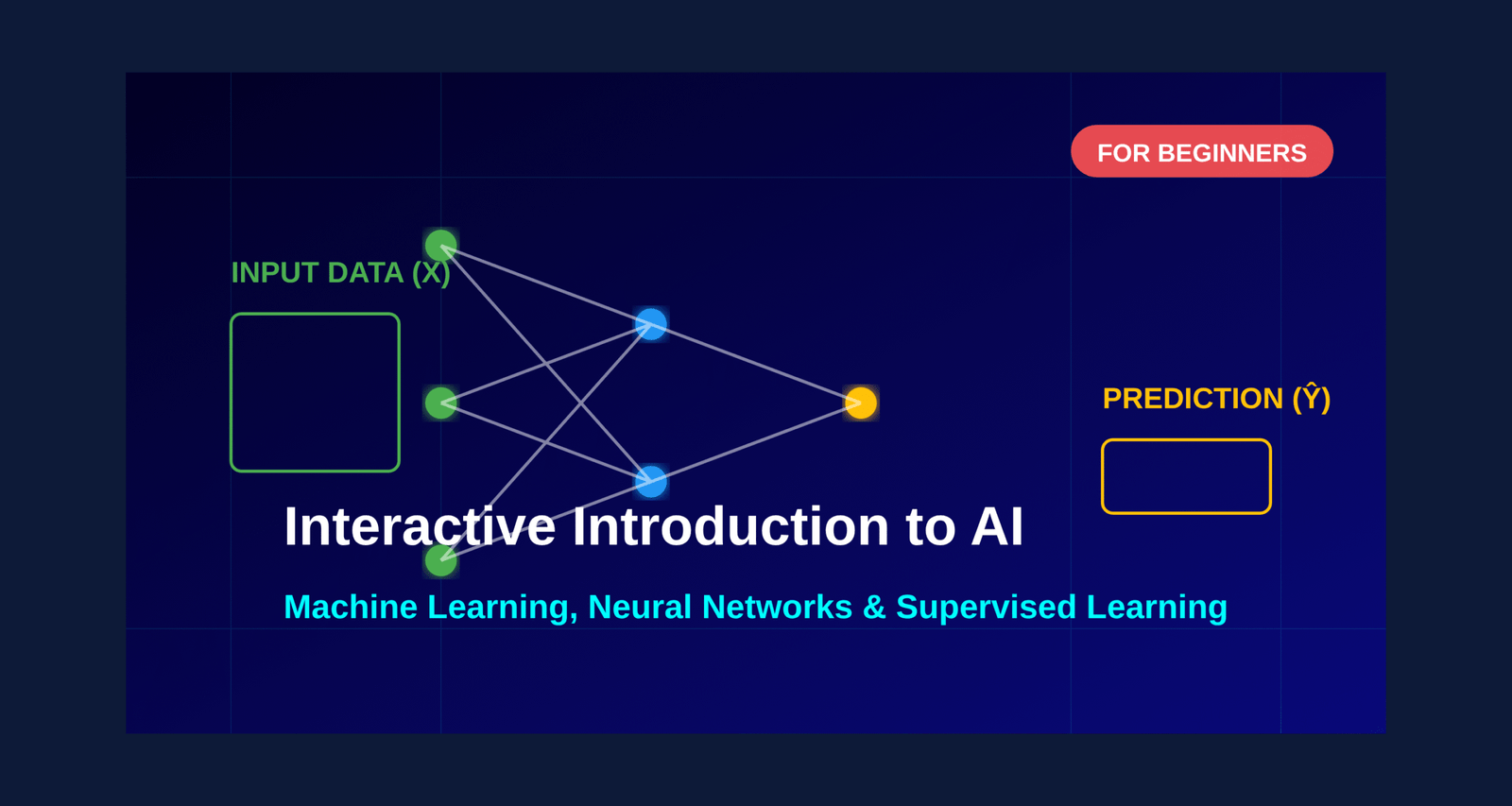
Interactive Introduction to AI: Machine Learning, Neural Networks & Supervised Learning for Beginners
Introduction to Artificial Intelligence
Don’t just read about AI – experience it!
Forget everything you think you know about AI articles. We’re not starting with definitions or history. Instead, you’re going to BE the AI for the next few minutes.
Experience #1: Think Like AI (Visual Pattern Recognition)
Look at this pattern. Three shapes are given, and one is missing. Can you identify the alternating color and shape pattern and click the correct answer?
Congratulations! You just did what AI does billions of times per second: pattern recognition. You identified a sequence (Blue Square, Red Circle, Blue Square) and predicted the next item (Red Circle). This is the foundation of artificial intelligence.
Defining AI: What Is Artificial Intelligence and Its Core Capabilities?
Now that you’ve experienced it, here’s the formal definition: Artificial Intelligence (AI) is a branch of computer science focused on creating systems that can perform tasks that typically require human intelligence. These tasks include reasoning, learning, problem-solving, perception, language understanding, and decision-making.
The AI you interacted with above demonstrates three core capabilities:
- Learning: Acquiring information and rules for using it
- Reasoning: Using rules to reach approximate or definite conclusions
- Self-correction: Continuously adjusting algorithms for accuracy
But AI does this at scale with:
- Millions of data points (not just 4 symbols)
- Lightning-fast processing
- Continuous learning and improvement
The Six Core Goals of Artificial Intelligence Research and Development
AI research and development pursue several fundamental objectives:
1. Problem Solving
Machines can solve complex problems efficiently by searching through possible solutions and selecting the optimal one. Chess engines evaluate millions of moves per second to find the best strategy.
2. Knowledge Representation
Systems store, organize, and retrieve information in ways that enable intelligent behavior. Medical diagnosis platforms maintain extensive disease databases to assist doctors in identifying conditions accurately.
3. Planning and Navigation
AI plans sequences of actions to achieve goals in dynamic environments. GPS systems calculate optimal routes while considering traffic conditions, road closures, and user preferences in real-time.
4. Natural Language Processing
Machines understand, interpret, and generate human language naturally. Virtual assistants like Alexa and Siri comprehend voice commands and respond appropriately in conversational contexts.
5. Perception
Systems interpret sensory data from the environment through vision, hearing, and touch. Facial recognition technology identifies individuals by analyzing unique facial features across millions of images.
6. General Intelligence
The ultimate aspiration involves creating machines with human-level intelligence across all domains. This remains theoretical and under active research, representing the frontier of AI development.
Strong AI vs Weak AI: Understanding the Spectrum
AI systems can be categorized into two fundamental types based on their capabilities:
Strong AI (Artificial General Intelligence)
AI systems with human-level consciousness, self-awareness, and ability to perform any intellectual task a human can do.
Characteristics:
- Consciousness and self-awareness
- Ability to reason across domains
- Transfer learning between tasks
- Emotional intelligence
- Creative problem-solving
Current Reality: Remains theoretical and does not exist yet. Science fiction AI like HAL 9000 and Jarvis represent this concept.
Weak AI (Narrow AI)
AI systems designed to perform specific tasks within a limited domain without consciousness or general intelligence.
Characteristics:
- Task-specific expertise
- No consciousness or understanding
- Limited to trained scenarios
- Cannot transfer knowledge easily
- Operates within boundaries
Current Reality: All existing AI falls into this category, including Siri, Netflix recommendations, and spam filters.
Key Distinction
Weak AI: “I can beat you at chess”
Strong AI: “I can beat you at chess, cook dinner, write poetry, and understand why you’re sad”
AI vs Machine Learning vs Deep Learning: Understanding the Technology Hierarchy
These terms are often confused. Here’s how they relate to each other:
Artificial Intelligence (Broadest)
The overarching field of computer science focused on creating intelligent machines. This encompasses all techniques that enable computers to mimic human intelligence, including rule-based systems, expert systems, machine learning, robotics, and natural language processing. A chess program using predefined rules to evaluate moves represents traditional AI.
Machine Learning (Subset of AI)
Systems learn from data without being explicitly programmed. Algorithms improve automatically through experience using supervised learning, unsupervised learning, and reinforcement learning techniques. Email spam filters that learn from examples of spam and legitimate emails exemplify this approach.
Deep Learning (Subset of ML)
Uses artificial neural networks with multiple layers for complex pattern recognition in large datasets. Techniques include Convolutional Neural Networks (CNN), Recurrent Neural Networks (RNN), and Transformers. Facial recognition systems that identify faces in photos demonstrate deep learning in action.
The Relationship:
AI (All intelligent systems) > ML (Learning from data) > DL (Multi-layer neural networks)
AI Approach
Follows pre-programmed rules and logic with minimal data requirements since rules are manually coded. Best suited for scenarios when rules are clear and fixed, like thermostat control systems that maintain temperature based on preset thresholds.
ML Approach
Learns patterns from training data with moderate structured dataset requirements. Ideal when patterns exist but rules remain unclear, such as credit card fraud detection that identifies suspicious transactions based on historical patterns.
DL Approach
Learns hierarchical features automatically from large datasets requiring millions of examples. Perfect for complex patterns in unstructured data, like self-driving car vision systems that recognize pedestrians, traffic signs, and road conditions simultaneously.
The Perfect Storm: Why AI is Important Now and Driving Market Growth
AI has existed as a concept since the 1950s, but three critical factors have converged in recent years to make AI practically viable and revolutionary:
1. Exponential Data Growth: Fueling Smarter AI Models
Humanity creates 2.5 quintillion bytes of data every day. By 2025, we generate 463 exabytes of data daily. Machine learning algorithms need massive amounts of data to learn effectively – more data equals smarter AI. The Internet of Things, smartphones, social media, and digital transactions provide endless training data that powers modern AI systems.
2. Computational Power Breakthrough: Enabling Deep Learning
Modern GPUs and specialized AI chips (TPUs) can perform trillions of calculations per second. Training deep learning models requires massive parallel processing that was impossible 20 years ago. Tasks that took months in 2010 now take hours, making complex neural networks practical for real-world deployment.
3. Algorithm Innovation: The Breakthroughs Driving Modern AI
Breakthroughs like backpropagation, transformers, and attention mechanisms have revolutionized AI capabilities. Better algorithms extract more value from data and compute power, enabling natural language understanding, image generation, and complex reasoning that seemed impossible just years ago.
4. Cloud Computing Accessibility: Democratizing AI Infrastructure
Cloud platforms democratize access to powerful AI infrastructure. Small companies and individuals can now access enterprise-level AI capabilities without massive capital investment. This accessibility accelerates innovation as barriers to entry decrease dramatically.
5. Economic Pressure: Driving Business Investment in AI
Businesses face intense competition and need efficiency gains to survive. AI offers automation, insights, and optimization that translate directly to competitive advantage. This economic reality drives massive investment flowing into AI research and development across all industries.
The AI Market Growth
Global AI market size: $136.55 billion (2022) projected to $1.81 trillion by 2030
That’s a compound annual growth rate of 38.1%
Experience #2: Train Your Own AI (Simulating Machine Learning Training)
Let’s simulate how AI learns. Draw a simple shape below, and watch the “AI confidence” meter react:
The more you draw, the more “training data” the AI gets!
The Three Pillars of Modern AI
Machine Learning
AI learns from examples without explicit programming
- Pattern recognition
- Prediction models
- Email spam filters
- Recommendation systems
Neural Networks
Inspired by human brain structure
- Deep learning
- Image recognition
- Language processing
- Voice assistants
Understanding AI Perception: How AI Sees the World with a Neural Network Simulator
When you identified the pattern (Blue Square, Red Circle), your brain processed information through a complex network of neurons. AI does the same! Click the button to watch the data flow through an **Artificial Neural Network** (ANN).
Click to start simulation…
Experience #3: AI Decision Making (Using a Classification Tree)
AI makes thousands of decisions every second. Experience how a simple AI decision tree works:
Experience #4: Supervised Learning Simulator
Supervised Learning is the most common type of machine learning, where the AI is trained on labeled examples. You provide the AI with input data (features) and the correct output (labels), and the AI learns the mapping function between them.
Training an Algorithm to Predict Outcomes: Supervised Learning Demo
Imagine the AI is learning the relationship between **Hours Studied** and **Exam Score**. Use the slider below (your labeled data) to see the AI’s prediction function in action. This is a simple linear regression model where the prediction is based directly on the input data.
Predicted Output (Exam Score):
This number is the result of the AI’s learned prediction function: Score ≈ (10 * Hours) + 5
You’ve just experienced AI in action. The key takeaway? AI isn’t magic—it’s pattern recognition, learning, and decision-making at scale.
The AI you interacted with above:
- ✅ Recognized patterns (blue-red sequence)
- ✅ Processed your drawing input
- ✅ Made decisions (classification tree)
AI = Data + Patterns + Learning + Decision Making
Every AI system, from simple chatbots to advanced robotics, follows this fundamental formula.
Comprehensive Real-World AI Applications Across Key Industries and Sectors
AI has moved from research labs into every sector of society. Here are comprehensive real-world applications:
Healthcare and Medicine: AI’s Role in Diagnosis and Drug Discovery
Disease Diagnosis
AI analyzes medical images like X-rays, MRIs, and CT scans to detect diseases including cancer, pneumonia, and diabetic retinopathy. Google’s DeepMind AI detects breast cancer with greater accuracy than human radiologists, enabling early detection that saves lives and reduces treatment costs.
Drug Discovery
Predicting how different compounds interact with disease targets accelerates pharmaceutical development dramatically. Atomwise uses AI to identify potential drugs from millions of molecules in days instead of years, reducing drug development time from 10+ years to 2-3 years.
Personalized Treatment
Patient genetics, lifestyle, and medical history combine to recommend tailored treatment plans. IBM Watson for Oncology suggests cancer treatment options based on comprehensive patient data, improving outcomes through targeted therapies specific to individual needs.
Virtual Health Assistants
AI chatbots provide 24/7 medical advice, symptom checking, and appointment scheduling. Babylon Health app triages patient symptoms using AI, reducing burden on healthcare systems while improving access to preliminary medical guidance.
Transportation and Automotive: The Rise of Autonomous Vehicles
Autonomous Vehicles
Self-driving cars use computer vision, sensor fusion, and deep learning to navigate roads safely. Tesla Autopilot and Waymo autonomous taxis operating in Phoenix and San Francisco demonstrate the potential to reduce 94% of accidents caused by human error.
Traffic Management
Optimizing traffic light timing and route planning based on real-time conditions transforms urban mobility. Los Angeles uses AI to reduce traffic congestion by 16%, cutting commute times and lowering emissions across the metropolitan area.
Predictive Maintenance
Forecasting vehicle component failures before they occur prevents costly delays and safety issues. Airlines leverage AI to predict engine failures with 30-40% reduction in downtime and maintenance costs while improving passenger safety.
Finance and Banking: AI for Fraud Detection and Algorithmic Trading
Fraud Detection
Analyzing transaction patterns identifies fraudulent activity in real-time, protecting consumers and financial institutions. Mastercard’s Decision Intelligence prevents $20 billion in fraud annually with accuracy rates exceeding 95%.
Algorithmic Trading
AI executes trades at optimal times based on sophisticated market analysis. Renaissance Technologies’ Medallion Fund uses AI for an impressive 66% average annual returns, with 70% of stock market trades now AI-driven.
Credit Scoring
Assessing creditworthiness using alternative data sources expands financial access. Upstart uses AI to approve 27% more borrowers than traditional models, increasing financial inclusion for underbanked populations.
Customer Service Chatbots
Handling customer inquiries, processing transactions, and resolving issues autonomously reduces costs dramatically. Bank of America’s Erica handles 1.5 billion client requests with an 80% reduction in customer service costs.
Retail and E-Commerce: Personalization and Dynamic Pricing with AI
Personalized Recommendations
Suggesting products based on browsing history, purchases, and similar user behaviors transforms online shopping. Amazon’s recommendation engine drives 35% of total sales with conversion rates increasing 10-30% across the platform.
Inventory Management
Predicting demand and optimizing stock levels prevents overstock and stockouts. Walmart uses AI to maintain optimal inventory across 10,000+ stores, reducing inventory costs by 20-30% while ensuring product availability.
Visual Search
Identifying products from photos uploaded by customers revolutionizes product discovery. Pinterest Lens allows users to shop by taking photos, achieving conversion rates 3x higher than traditional text search.
Dynamic Pricing
Adjusting prices in real-time based on demand, competition, and inventory maximizes revenue. Airlines and hotels use AI for revenue optimization, achieving revenue increases of 5-10% through intelligent pricing strategies.
Manufacturing and Industry: Using AI for Quality Control and Predictive Maintenance
Quality Control
Computer vision AI inspects products for defects faster and more accurately than humans. Foxconn uses AI to inspect iPhone components at scale, achieving 99.9% accuracy in defect detection across millions of units.
Predictive Maintenance
Monitoring equipment sensors forecasts failures before they occur. GE uses AI to predict turbine failures in power plants, reducing downtime by 30-50% while preventing costly emergency repairs.
Robotic Automation
AI-powered robots handle complex assembly tasks with precision and consistency. Tesla’s factories use AI robots for vehicle assembly, increasing production efficiency by 40% while maintaining quality standards.
Education and Learning: Personalized Tutoring and Automated Grading Systems
Personalized Learning
Adapting educational content to individual student needs and pace transforms education outcomes. Khan Academy uses AI to create customized learning paths, improving student performance by 25% through tailored instruction.
Automated Grading
AI grades essays, assignments, and provides detailed feedback to students. Gradescope uses AI to grade exams and assignments, saving teachers 30+ hours per month for more valuable student interaction time.
Intelligent Tutoring Systems
Providing one-on-one tutoring and answering student questions enhances learning accessibility. Carnegie Learning’s MATHia provides personalized math tutoring, improving learning outcomes by 20-30% compared to traditional instruction.
Entertainment and Media: AI-Powered Content Recommendation and Generation
Content Recommendation
Suggesting movies, music, and content based on user preferences keeps audiences engaged. Netflix’s recommendation algorithm saves $1 billion annually in retention, with 80% of Netflix views coming from AI-powered recommendations.
Content Generation
Creating music, art, and written content opens new creative possibilities. DALL-E generates images from text descriptions while ChatGPT writes articles, providing new creative tools for artists and writers worldwide.
Game AI
Creating realistic non-player characters and adaptive gameplay enhances entertainment experiences. AlphaGo defeated world champion Go player, demonstrating AI’s ability to create more engaging and challenging gaming experiences.
Agriculture: Precision Farming and Crop Disease Detection with AI
Precision Farming
Analyzing soil, weather, and crop data optimizes planting and harvesting decisions. John Deere’s AI tractors adjust seeding rates in real-time, increasing crop yields by 15-30% while reducing resource waste.
Pest and Disease Detection
Identifying plant diseases from images enables rapid intervention. PlantVillage uses AI to diagnose crop diseases via smartphone, reducing crop losses by 20-40% through early detection and treatment.
Cybersecurity: AI for Real-Time Threat Detection and Malware Analysis
Threat Detection
Identifying anomalies and potential security breaches in real-time protects digital infrastructure. Darktrace uses AI to detect zero-day attacks, reducing threat detection time from days to minutes with proactive defense.
Malware Analysis
Analyzing code patterns identifies new malware variants before they spread. CrowdStrike uses AI to detect 450,000+ malware variants daily, achieving 99% malware detection accuracy across global networks.
AI Impact by Numbers
Your AI Journey Starts Now
Now that you’ve experienced AI firsthand, you understand it better than most people who’ve only read about it. You’ve been the AI, made the predictions, and seen how machines learn.
Remember: AI isn’t about replacing human intelligence—it’s about augmenting it. Just like you solved that pattern, AI solves patterns in data we can’t even see.
Challenge Yourself
Try the interactive demos again. Each time you do, you’re training your brain to think like an AI developer!
External Resources
| Category | URL (Opens in Separate Tab) |
| I. Core Definitions & Concepts | Artificial intelligence – Wikipedia |
| What Is Artificial Intelligence (AI)? – IBM | |
| II. Market Growth & Statistics | Artificial Intelligence [AI] Market Size, Growth & Trends by 2032 – Fortune Business Insights |
| 79 Artificial Intelligence Statistics for 2025 – Semrush | |
| III. Real-World Applications | Top AI Use Cases in Healthcare, Finance, and Retail – Grow Data Skills |
| Top Artificial Intelligence Applications Revolutionizing Healthcare, Finance, and Retail in 2025 – nasscom | |
| [IQVIA AI – Smarter |
Frequently Asked Questions (FAQ)
1. What is the difference between AI, Machine Learning (ML), and Deep Learning (DL)?
AI (Artificial Intelligence) is the broadest field—the science of making machines intelligent, capable of mimicking human cognitive functions.
Machine Learning (ML) is a subset of AI. It involves systems that learn from data to identify patterns and make decisions without being explicitly programmed for every scenario.
Deep Learning (DL) is a subset of ML. It uses large Artificial Neural Networks (with multiple layers—hence “deep”) to solve highly complex tasks like image and speech recognition.2. Is AI always objective and unbiased?
No. AI systems are only as objective as the data they are trained on. If the training data reflects existing human, social, or historical biases (e.g., gender or racial biases), the AI model will learn and, in some cases, even amplify those biases in its output or decisions. Human oversight is critical for ensuring fairness and ethical use.
3. Will AI replace all human jobs?
This is a common misconception. While AI will automate repetitive, data-intensive tasks, it is more likely to augment human capabilities rather than replace them entirely. The focus is shifting to jobs that require human traits like creativity, critical thinking, strategic planning, and emotional intelligence. AI will create new job categories that require people to manage, maintain, and develop these sophisticated systems.
4. What are the main types of AI?
AI is typically categorized based on its capability:
Artificial Narrow Intelligence (ANI) or Weak AI: This is the AI that exists today. It is designed and trained to perform a specific, narrow task (e.g., Siri, self-driving cars, recommendation engines).
Artificial General Intelligence (AGI) or Strong AI: This is theoretical AI that possesses the ability to understand, learn, and apply its intelligence to solve any problem that a human being can.
Artificial Super Intelligence (ASI): A hypothetical future state where AI surpasses human intelligence in virtually every field.5. Does AI think or feel like a human?
No. Current AI (ANI) systems are highly complex pattern-matching tools. While they can be programmed to recognize, simulate, and even respond to human emotional cues (e.g., a chatbot detecting frustration), they do not possess consciousness, self-awareness, or genuine feelings. They operate purely on mathematical models and algorithms.




Leave a Reply