
AI Winter Explained: How Funding Cuts, Failed Promises, and Market Shifts Shaped the Future of Artificial Intelligence
What Is AI Winter? The Rise, Fall, and Revival of Artificial Intelligence
In 1973, the British government asked physicist James Lighthill to review progress in artificial intelligence research. His report concluded that researchers had not achieved their stated objectives. Within a year, UK funding for AI research dropped sharply. Many programs closed. This pattern repeated across multiple countries between 1974 and 1980, then again from 1987 to 1993. Researchers coined the term “AI Winter” to describe these periods when funding dried up, companies failed, and the field nearly disappeared. Understanding what happened helps you make informed decisions about AI careers, business investments, and technology adoption today.
Understanding AI Winter as a Historical Phenomenon
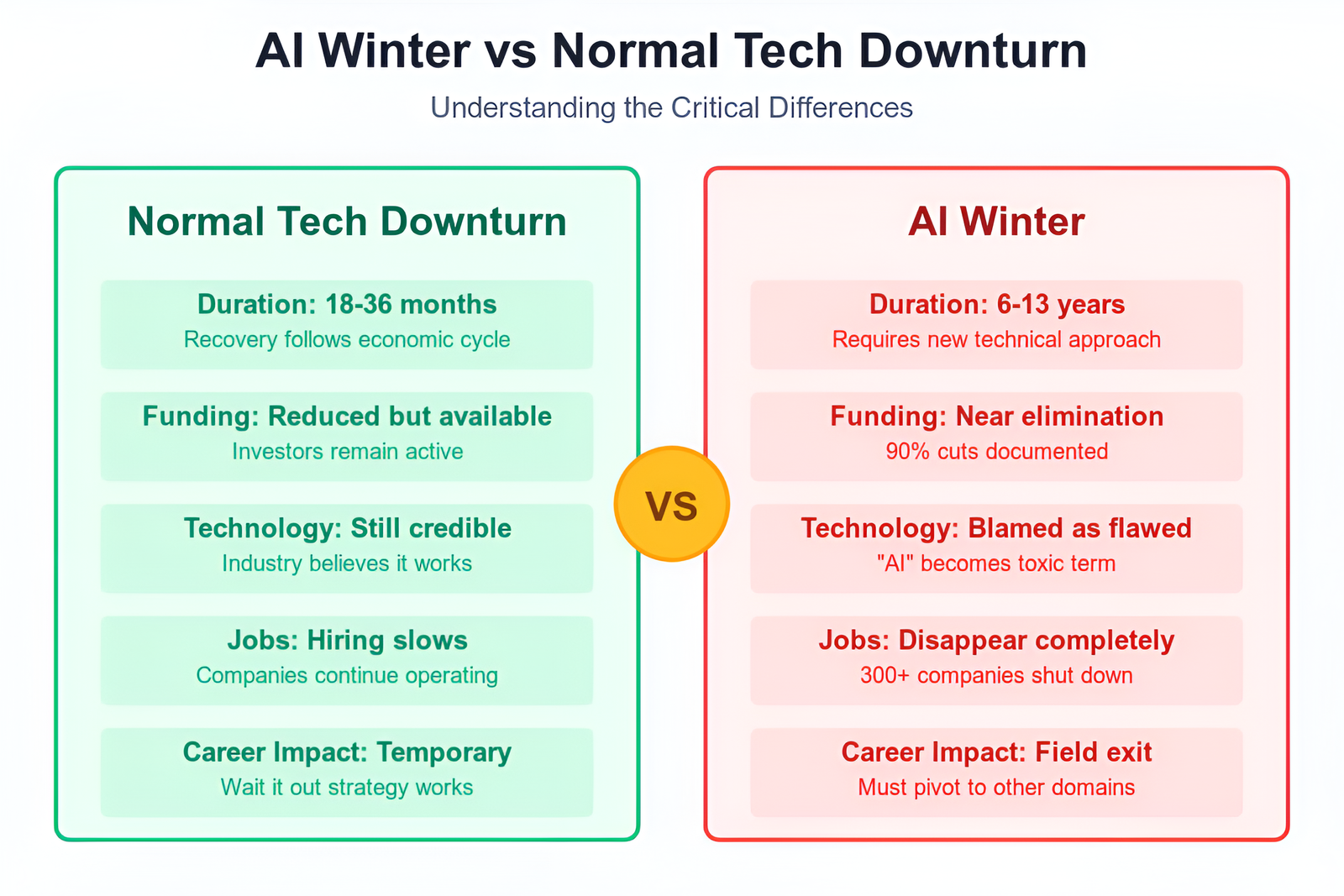
AI Winter describes a specific pattern where artificial intelligence research experiences rapid, widespread contraction. Funding drops dramatically. Companies shut down. Universities close programs. Job opportunities vanish. The term “artificial intelligence” becomes difficult to use in funding proposals.
This differs from normal technology market corrections. During regular downturns, funding becomes harder to get but remains available. Companies reduce hiring but continue operating. The technology itself stays credible.
During AI Winter, the technology loses credibility. Funding becomes nearly impossible to secure. Companies fail at high rates. Researchers rebrand their work to avoid the AI label entirely.
| Aspect | Regular Downturn | AI Winter |
|---|---|---|
| Duration | 18-36 months typically | 6-13 years documented |
| Funding Availability | Reduced but accessible | Near complete elimination |
| Technology Credibility | Remains viable | Considered fundamentally flawed |
| Career Impact | Temporary setbacks | Field exit often required |
First AI Winter Period 1974 to 1980
The first AI Winter began after government agencies evaluated progress against earlier predictions. Between 1956 and 1973, researchers received substantial funding based on optimistic forecasts about when machines would achieve human-level capabilities.
The Lighthill Report and British Funding Cuts
In 1973, James Lighthill delivered a report to the British Science Research Council. The report stated that AI research had not delivered on promises and identified technical barriers including combinatorial explosion problems that prevented systems from scaling.
Following this report, the UK government reduced AI research funding significantly. Only a few universities maintained small programs. Large-scale research did not resume until the 1980s.
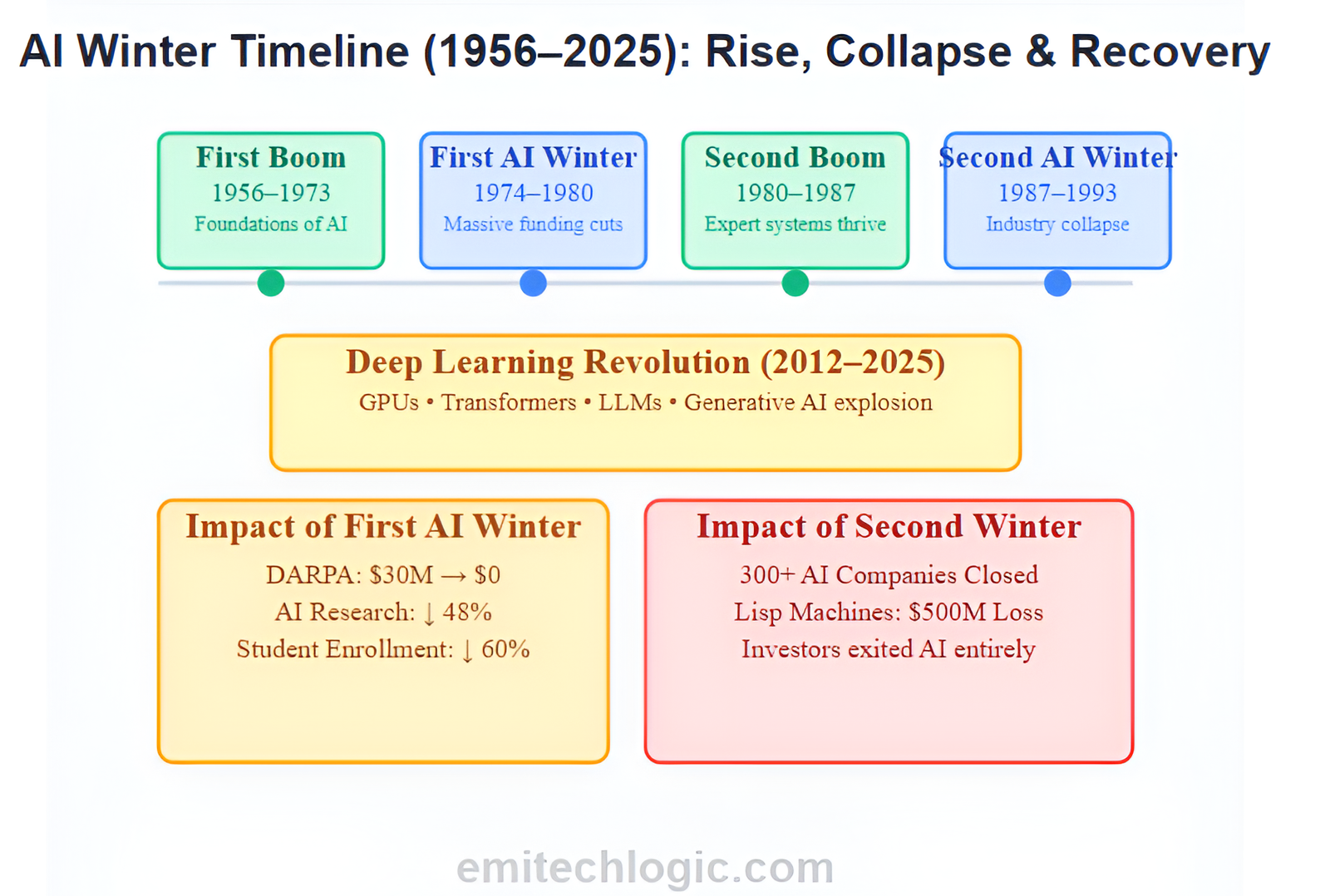
According to Computing Research Association analysis, academic publications about artificial intelligence declined approximately 48 percent between 1974 and 1980. Graduate program enrollment in AI specializations fell over 60 percent during the same period.
US Defense Funding Reduction
The Defense Advanced Research Projects Agency had funded AI research with relatively few constraints through the early 1970s. By 1974, annual funding dropped from approximately $30 million to minimal levels.
This reduction reflected both budget pressures and disappointment with results. The 1973 Mansfield Amendment also required DARPA to justify research projects based on specific military applications rather than basic research value.
The ALPAC Report on Machine Translation
In 1966, the Automatic Language Processing Advisory Committee evaluated machine translation research funded by the US government. After $20 million invested, the committee concluded that automatic translation remained inferior to human translation and showed limited prospects for improvement.
Following this report, the National Research Council ended support for machine translation research.
AI Recovery Through Expert Systems 1980 to 1987
AI research recovered in the 1980s through a different approach. Rather than pursuing general artificial intelligence, researchers focused on expert systems that captured specialized human knowledge for specific tasks.
XCON Configuration System at Digital Equipment Corporation
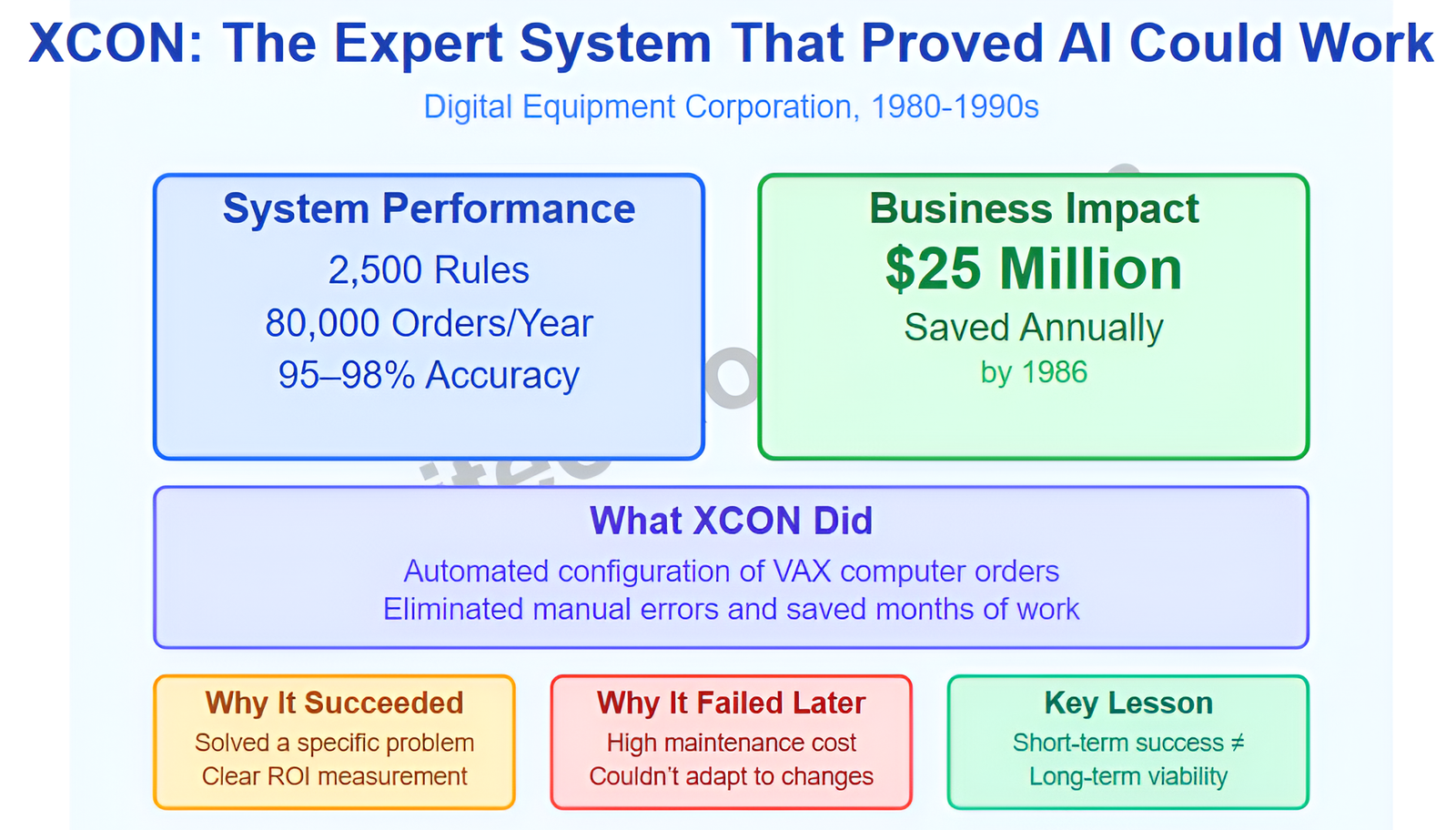
John McDermott at Carnegie Mellon University developed XCON starting in 1978. The system automated configuration of VAX computer orders for Digital Equipment Corporation.
XCON System Details:
The system contained approximately 2,500 rules encoding knowledge about computer component compatibility. By 1986, XCON processed 80,000 orders annually with 95-98 percent accuracy. DEC estimated annual savings of $25 million from reduced errors and faster processing.
Before XCON, sales personnel had to specify every component manually. Errors were common and expensive. XCON automated this process by asking questions and generating complete, compatible specifications.
MYCIN Medical Diagnosis System
Stanford University researchers developed MYCIN in the early 1970s. The system diagnosed blood infections and recommended antibiotic treatments using approximately 500-600 rules.
Stanford Medical School evaluation showed MYCIN achieved 65 percent acceptability for treatment recommendations. This compared to 42.5-62.5 percent for faculty specialists in the evaluation.
Despite this performance, MYCIN never entered clinical practice due to legal liability concerns and practical barriers to hospital integration.
Commercial Investment Growth
By 1985, corporations invested over $1 billion annually in AI, primarily through expert systems. Japan announced its Fifth Generation Computer Systems project in 1981 with $850 million in funding. This sparked competitive responses from the United States and Europe.
Second AI Winter Period 1987 to 1993
The expert systems boom ended when several factors converged around 1987. Specialized hardware became obsolete. Maintenance costs exceeded system value. DARPA funding declined sharply.
Lisp Machine Market Collapse
Lisp machines were specialized computers optimized for AI programming. Companies sold these machines for approximately $70,000 each. About 7,000 units sold by 1988.
When Apple and Sun Microsystems released general-purpose workstations matching Lisp machine performance at significantly lower cost, the specialized hardware market collapsed. Most companies producing these machines went bankrupt by 1990.
Over 300 AI companies shut down, went bankrupt, or were acquired between 1987 and 1993. An industry worth approximately half a billion dollars in specialized hardware essentially disappeared.
Expert System Maintenance Problems
Expert systems worked initially but revealed scalability problems as deployments matured. Three issues drove abandonment:
Knowledge acquisition required months of interviewing experts to extract and encode decision-making logic as rules. When business conditions changed, this entire process had to repeat.
Maintenance costs grew as systems needed continuous updates. Rules worked for common scenarios but failed on exceptions, requiring additional rules that increased system complexity.
Integration challenges emerged as expert systems often required specialized hardware or programming languages that did not work well with existing business systems.
Technology Changes That Enabled AI Recovery
AI recovered not through algorithm breakthroughs alone but through convergence of multiple technology trends that eliminated previous bottlenecks.
Graphics Processing Units
GPU development for video games and graphics created processors with thousands of cores optimized for parallel operations. Researchers found this architecture matched neural network training requirements, reducing training time significantly.
Internet Data Generation
The internet, digital cameras, smartphones, and social media generated unprecedented data volumes. Companies accumulated billions of examples for training machine learning systems.
Open Source Software
Large technology companies released neural network frameworks as open source software. TensorFlow from Google and PyTorch from Facebook allowed researchers to build sophisticated models without implementing algorithms from scratch.
Cloud Computing Infrastructure
Amazon Web Services, Microsoft Azure, and Google Cloud Platform enabled renting computational resources on demand. Organizations could access powerful infrastructure without large hardware investments.
Comparing Current AI to Previous Cycles
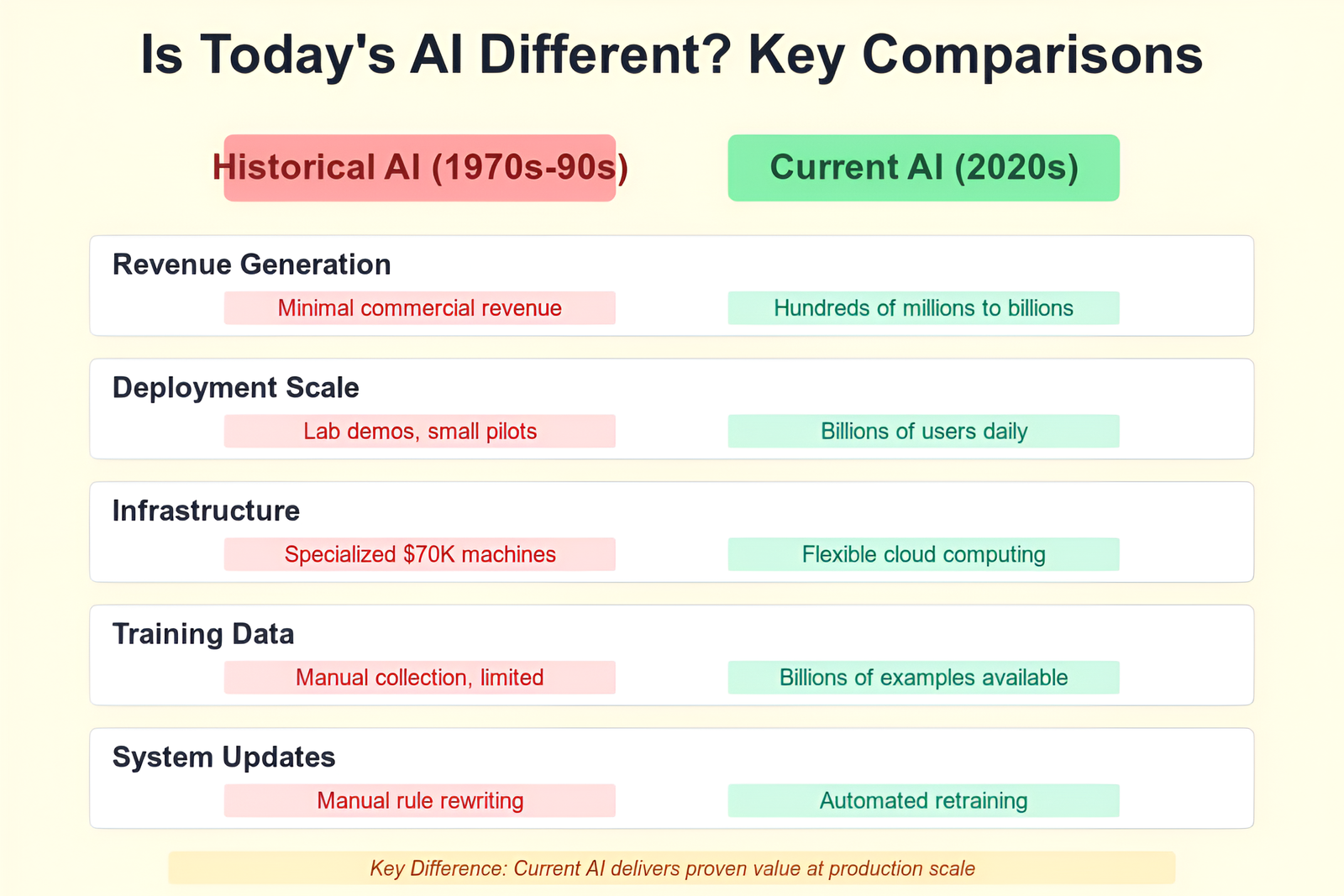
Today’s AI operates under different conditions than previous eras. Some differences suggest greater stability while some patterns resemble historical cycles.
Research produced primarily laboratory demonstrations. Commercial revenue remained minimal. Deployment occurred in small pilots. Specialized hardware created vendor lock-in.
Systems operate in production serving millions of users. Companies generate substantial revenue. Deployment occurs at scale across industries. General-purpose hardware provides flexibility.
Factors Suggesting Greater Stability
Current AI generates measurable revenue at significant scale. Companies including OpenAI and established technology firms report hundreds of millions to billions in AI-related revenue.
AI integrates deeply into business operations across industries. Healthcare, finance, manufacturing, and retail use AI for core processes. Removal would be costly and disruptive.
Technology demonstrates capability at production scale. Systems handle real-world workloads reliably rather than only functioning in controlled demonstrations.
Remaining Concerns
Infrastructure costs for large models remain high. Some companies price services below cost, relying on investment funding rather than sustainable economics.
Many startups build similar products using the same underlying models with limited differentiation. This commoditization may reduce profit margins industry-wide.
Questions remain about how many current use cases will generate sufficient value for customers to pay realistic prices covering infrastructure costs.
Practical Guidance for Career Planning
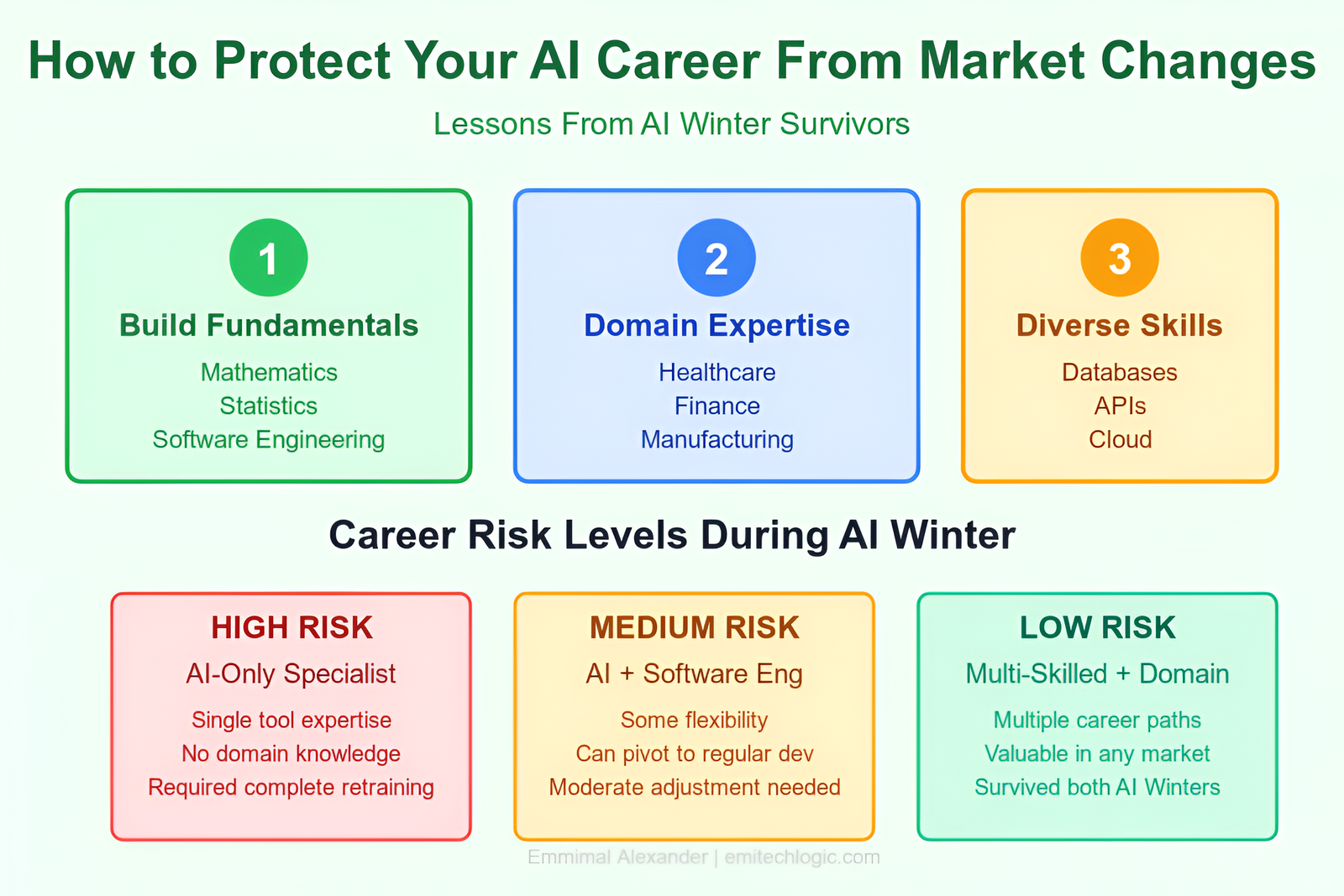
Historical evidence from AI Winter periods informs practical career strategies regardless of whether another contraction occurs.
Build Fundamental Technical Skills
Focus on mathematics, statistics, software engineering, and system design rather than specific AI frameworks. These fundamentals remain valuable across technology changes.
During previous AI Winters, professionals with strong fundamentals successfully moved to adjacent fields. Knowledge engineers became business analysts. AI researchers moved into data science. Robotics engineers worked in automation.
Combine AI With Domain Expertise
Deep knowledge in healthcare, finance, manufacturing, or other industries provides value independent of AI trends. Position yourself as a domain expert who uses AI as one tool rather than an AI specialist.
Maintain Diverse Technical Capabilities
Keep skills current in conventional software development, databases, and infrastructure alongside AI knowledge. This diversity provides career options if AI opportunities contract.
Building Sustainable AI Businesses
Historical patterns suggest business strategies that increase sustainability during market contractions.
Target Problems With Measurable Return on Investment
XCON succeeded because Digital Equipment Corporation could calculate exact savings from reduced configuration errors. Focus on specific problems where customers can measure value clearly.
Control Technology Dependencies
Companies depending entirely on Lisp machines failed when that hardware became obsolete. Where feasible, use open source alternatives or build flexibility to switch providers.
Achieve Profitable Unit Economics
During the 1980s boom, over $1 billion flowed into AI with minimal revenue generation. When funding dried up, most companies failed. Build business models that work without continuous fundraising.
Timeline Reference
AI research receives substantial government funding. Researchers develop symbolic reasoning, early natural language processing, and problem-solving programs. Optimistic predictions about human-level AI timelines shape funding expectations.
ALPAC Report evaluates machine translation. After $20 million invested, committee concludes automatic translation remains inferior to human translation. National Research Council ends support.
Lighthill Report delivered to British Science Research Council. Report states AI research has not achieved objectives. Mansfield Amendment requires military justification for DARPA research funding.
First AI Winter. DARPA funding drops from approximately $30 million annually to minimal levels. UK dismantles AI research programs. Academic publications fall 48 percent. Graduate enrollment declines over 60 percent.
John McDermott develops XCON at Carnegie Mellon. System enters production at Digital Equipment Corporation in 1980, eventually containing 2,500 rules and processing 80,000 orders yearly.
Japan announces Fifth Generation Computer Systems project with $850 million funding. United States and Europe respond with increased AI investment.
Expert systems boom. Corporate AI investment exceeds $1 billion annually by 1985. Specialized Lisp machine market grows. DARPA launches Strategic Computing Initiative.
Lisp machine market collapses as general-purpose computers match performance at lower cost. DARPA begins cutting AI funding. Expert system maintenance costs begin exceeding value for many deployments.
Second AI Winter. Over 300 AI companies shut down, go bankrupt, or get acquired. Lisp machine manufacturers fail. Fifth Generation project ends without meeting objectives.
Gradual recovery. Machine learning advances without AI branding. Internet generates training data. Computing costs decrease. Statistical methods prove more adaptable than rule-based systems.
ImageNet competition breakthrough using deep neural networks. GPU-accelerated training enables practical deep learning. Modern AI era begins.
Key Questions Answered
Will another AI Winter definitely happen?
Not necessarily. Current AI has stronger foundations including real revenue generation and broad adoption. However, market corrections affecting AI companies remain possible even if underlying technology continues advancing.
How would I recognize AI Winter starting?
Historical indicators included dramatic funding reductions, high-profile project failures, companies removing AI features, increasing skepticism in mainstream publications, and regulatory restrictions.
What industries are most stable for AI careers?
Industries where AI already delivers measurable value: search technology, e-commerce recommendations, financial fraud detection, manufacturing quality control, and medical imaging analysis.
Should I avoid AI careers entirely?
No. Build diversified skills combining AI with software engineering, domain expertise, and business understanding. This approach provides value regardless of market conditions.
What differs most between now and previous cycles?
Scale of deployment and revenue generation. Historical AI remained largely in research labs with minimal commercial revenue. Current AI operates in production environments serving billions of users and generating substantial revenue across multiple industries.
Conclusion
AI Winter occurred twice in documented history when specific conditions aligned: promises exceeded delivery, systems worked in controlled settings but failed in production, maintenance costs exceeded value, and specialized infrastructure became economically unviable.
Understanding these patterns helps evaluate current AI development, make informed career decisions, and assess business strategies. Whether another contraction occurs or growth continues, knowledge of historical patterns supports better decision making.
This guide provides factual information about AI Winter periods to help readers understand historical patterns and make informed decisions about AI-related careers, investments, and strategies.
External Resources on AI Winter
1. Historical Background of AI Winter
- Lighthill Report (1973)
Full report published by the UK Science Research Council.
https://www.chilton-computing.org.uk/inf/literature/reports/lighthill_report/p001.htm - ALPAC Report (1966)
United States Automatic Language Processing Advisory Committee findings.
https://www.nap.edu/catalog/9547/language-and-machines-computers-in-translation-and-linguistics - DARPA Strategic Computing Initiative (1983–1993)
Historical archive from RAND.
2. Academic Papers and Retrospectives
- Nils J. Nilsson – Historical Overview of AI
https://ai.stanford.edu/~nilsson/MLBOOK.pdf - “Deep Learning in Neural Networks: An Overview” — Jürgen Schmidhuber
Includes historical evolution before and after AI Winter periods.
3. Expert Systems and Recovery Phase
- XCON / R1 Expert System Case Study (Carnegie Mellon)
- MYCIN System Technical Documentation (Stanford)
- Fifth Generation Computer Systems Project (Japan)
Government-published overview of objectives and outcomes.
4. Technical Evolution That Ended AI Winter
- NVIDIA GPU Architecture Papers
- Apache Foundation – Machine Learning and Big Data Ecosystem
https://apache.org/ - TensorFlow Whitepaper (Google)
- PyTorch Documentation and Research
- AWS Cloud Infrastructure Papers
https://aws.amazon.com/whitepapers/
5. Modern AI Economics and Commercial Use
- Stanford AI Index Report (annual)
Comprehensive data on investment, commercial adoption, and research. - OECD AI Policy Observatory
Government-level reports on AI investment and risk.
https://oecd.ai/
Frequently Asked Questions (FAQs)
1. Why did AI Winter happen despite early breakthroughs in artificial intelligence?
AI Winter occurred because early AI systems worked in controlled laboratory settings but failed when applied to real-world problems. Governments and companies expected rapid progress toward human-level intelligence, but technical limitations such as combinatorial explosion, limited computing power, and poor scalability led to disappointment and large funding cuts.
2. How is the modern AI ecosystem different from the periods that led to AI Winter?
Modern AI benefits from massive datasets, GPU-accelerated computing, cloud infrastructure, and open-source frameworks. Most importantly, today’s AI systems generate measurable commercial revenue across many industries, which makes the ecosystem more resilient compared to earlier decades when AI research had minimal real-world deployment.
3. Are current AI tools at risk of triggering another AI Winter?
A full AI Winter is unlikely, but a market correction remains possible. Some companies depend heavily on investor funding, and infrastructure costs for large models are high. If expectations exceed what current systems can deliver, certain segments—especially startups without strong revenue models—may contract even if the underlying technology continues to advance.
4. What can students or professionals do to protect their careers if an AI downturn happens again?
Focusing on core skills such as mathematics, programming, system design, and domain expertise helps ensure career stability. Professionals who maintain a broad skill set and demonstrate measurable business impact remain valuable even when AI-specific jobs shrink temporarily.
5. Which industries are the safest for long-term AI careers?
Industries where AI already provides measurable value tend to be more stable. These include financial fraud detection, e-commerce recommendations, search technology, manufacturing quality control, and medical imaging. These sectors rely on AI for essential operations rather than experimental projects, making AI roles more secure.



Leave a Reply