
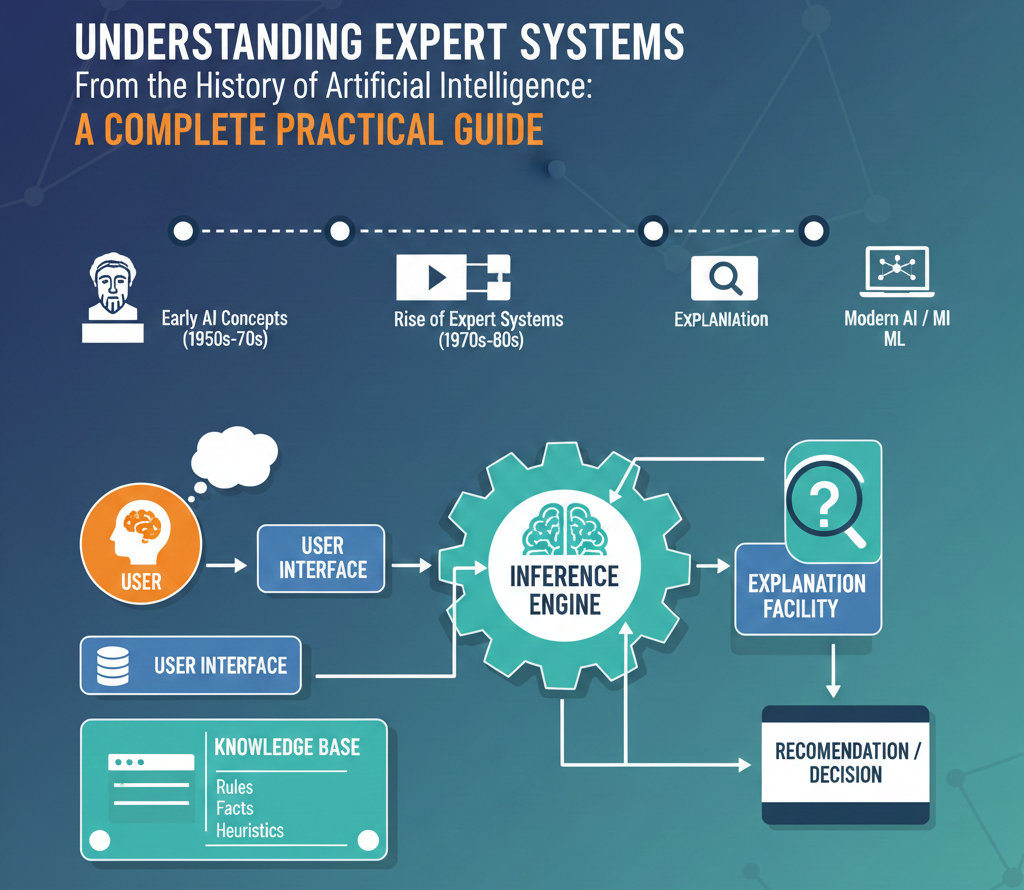
Expert Systems: A Complete Guide
Understanding Expert Systems from the History of Artificial Intelligence: A Complete Practical Guide
Before machine learning became popular, expert systems were the main way computers made smart decisions. These systems used clear rules written by human experts to solve problems. Today, they still teach us valuable lessons about building AI that people can understand and trust.
Why Rule-Based Expert Systems Still Matter in Modern AI Development
Expert systems came before neural networks. They worked by storing knowledge from human experts as simple rules. Think of them like a digital version of an instruction manual written by the best professionals in a field.
Here is the big difference: Expert systems use clear rules that humans write down. Modern machine learning finds patterns in data automatically. Neither approach is always better. The right choice depends on your specific problem.
Why should you care about expert systems today? Because they solve real problems that machine learning cannot handle well. Banks use rule systems to follow government regulations. Hospitals use them to check if prescribed medicines might interact badly. These systems need to explain their decisions clearly, which expert systems do very well.
Real World Example
A bank wants to approve loans. They could use machine learning to predict who will repay. But they also need rules like “never approve a loan above 5 times the person’s annual income.” Machine learning might learn this pattern, but it might also break this rule sometimes. An expert system always follows the rule exactly.
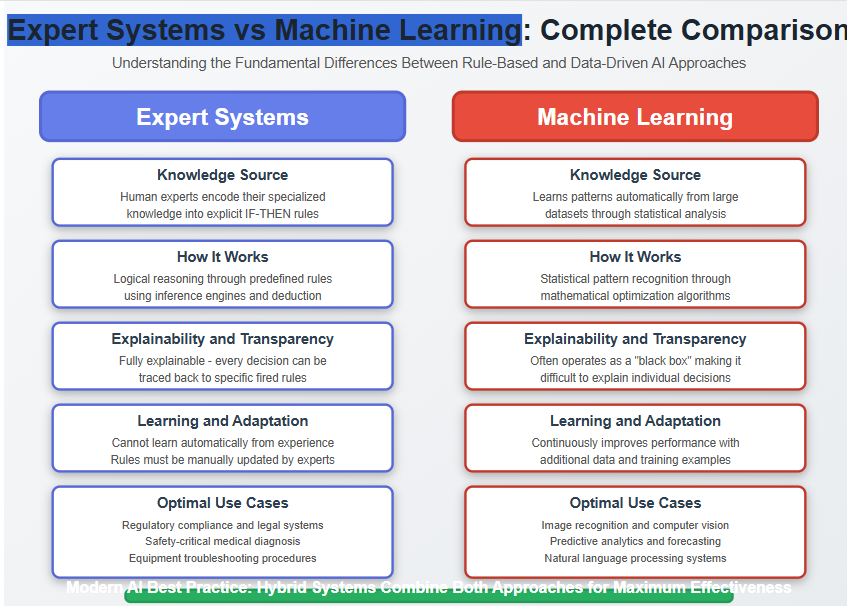
How Expert Systems Differ from Machine Learning
Humans write the rules
Always explainable
Knowledge from experts
Computer finds patterns
Sometimes a black box
Learns from data
What Defines an Expert System in Artificial Intelligence Applications
An expert system is a computer program that makes decisions like a human expert would. It stores knowledge as rules and uses logic to reach conclusions.
The system has two main parts kept separate: the knowledge (rules about the domain) and the reasoning engine (the part that applies those rules). This separation is powerful because experts can change the rules without needing programming skills.
Basic Parts of an Expert System
Think of It Like This
Imagine you take your car to a mechanic. The mechanic asks questions: Does the engine start? Do you hear clicking sounds? Is the battery light on? Based on your answers, the mechanic follows a mental checklist of possible problems. An expert system does the same thing, but the checklist is written as computer rules.
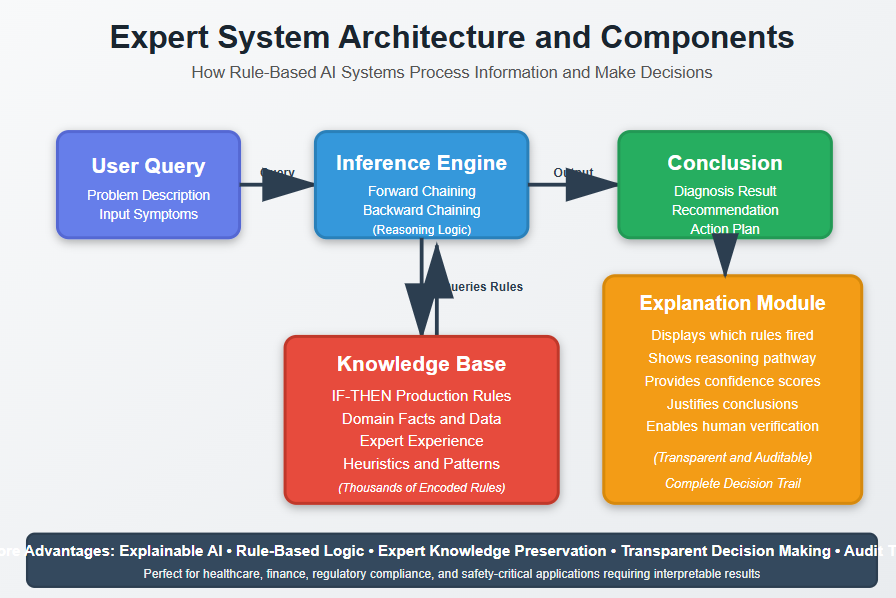
Essential Components That Power Expert System Reasoning Engines
Knowledge Base Structure and Rule Representation Methods
The knowledge base holds all the expert information. Most systems store this as IF-THEN rules. These rules connect conditions to actions or conclusions.
Getting this knowledge is tricky. Experts often make decisions without thinking about their exact process. A doctor might instantly recognize a disease from symptoms but struggle to explain the precise rules they follow. Knowledge engineers interview experts and watch them work to write down these hidden rules.
Simple Medical Rules Example
Rule 1: IF temperature is above 38.5 degrees AND white blood cells are high AND patient has pain in one area THEN suspect bacterial infection
Rule 2: IF bacterial infection is suspected AND infection is in lungs THEN order a sputum test
Rule 3: IF sputum test shows certain bacteria AND patient is over 65 years old THEN prescribe ceftriaxone antibiotic at high dose
Notice how these rules chain together. The conclusion from one rule becomes a condition for the next rule.
Large systems organize rules into groups. A car diagnostic system might have separate groups for electrical problems, fuel problems, and engine problems. Higher-level rules decide which group to check first based on the main symptom.
Inference Engine Mechanisms and Reasoning Strategies
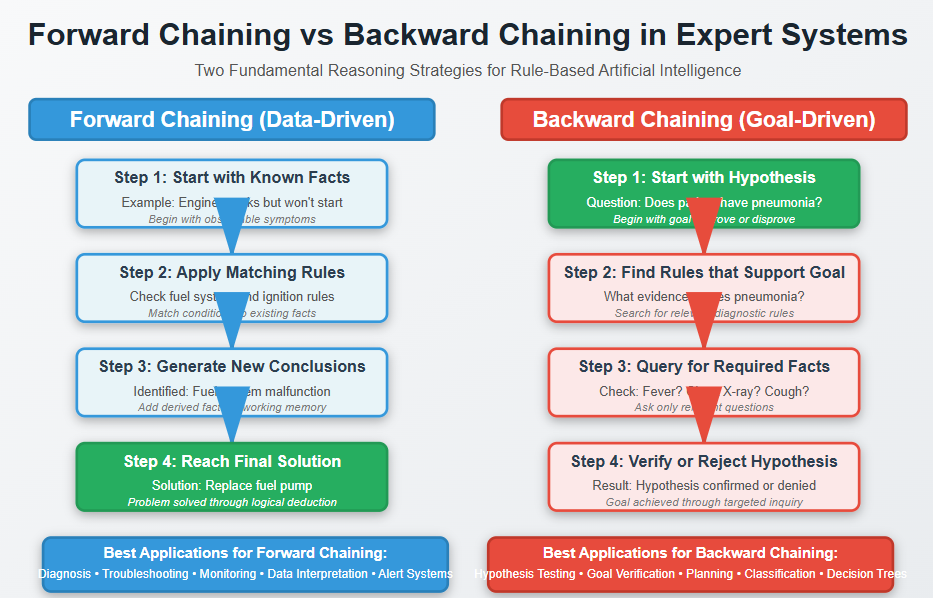
The inference engine is the brain that decides which rules to use and when. It takes the rules from the knowledge base and applies them to solve your problem.
There are two main ways the engine can work:
Forward Chaining (Data-Driven)
Start with what you know and keep applying rules until you reach a conclusion. Like following clues to solve a mystery.
Best for: Diagnosis, monitoring, and figuring out what something means
Backward Chaining (Goal-Driven)
Start with a possible answer and work backwards to see if the facts support it. Like a detective testing different theories.
Best for: Planning and checking if something is possible
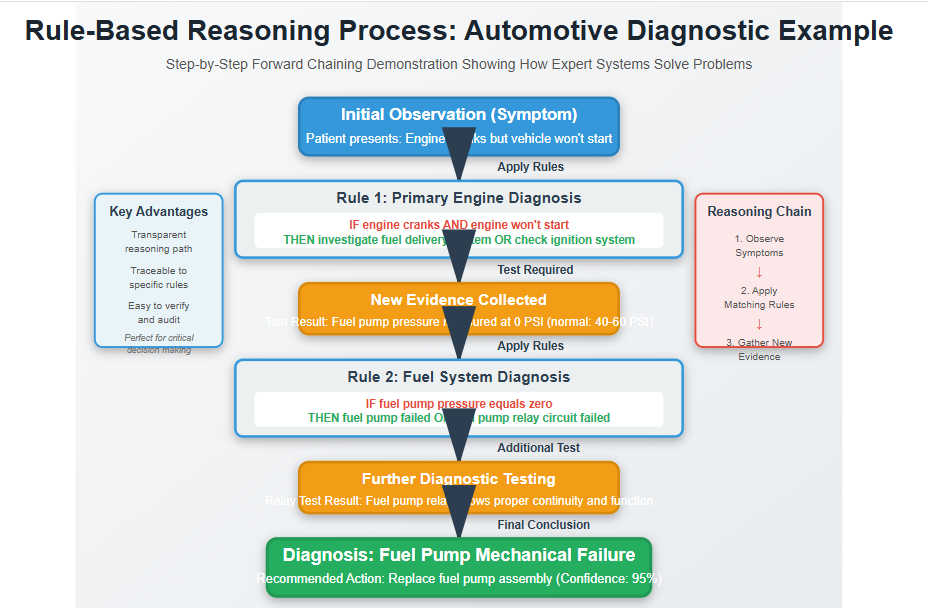
Forward Chaining Example: Car Won’t Start
The best part about rule-based reasoning is you can always trace back exactly why the system made its decision. Every conclusion points to specific rules and facts. This transparency matters in medicine, finance, and other critical fields where people need to verify the system’s logic before acting on it.
User Interface Design Patterns for Expert System Interaction
Good expert systems ask questions in a logical order. They do not overwhelm you with 50 questions at once. Instead, they ask a few key questions first, then ask follow-up questions based on your answers.
The system should explain why it needs information. Instead of just asking “What is the engine temperature?” it might say “I need to know the engine temperature to determine if overheating caused the failure.”
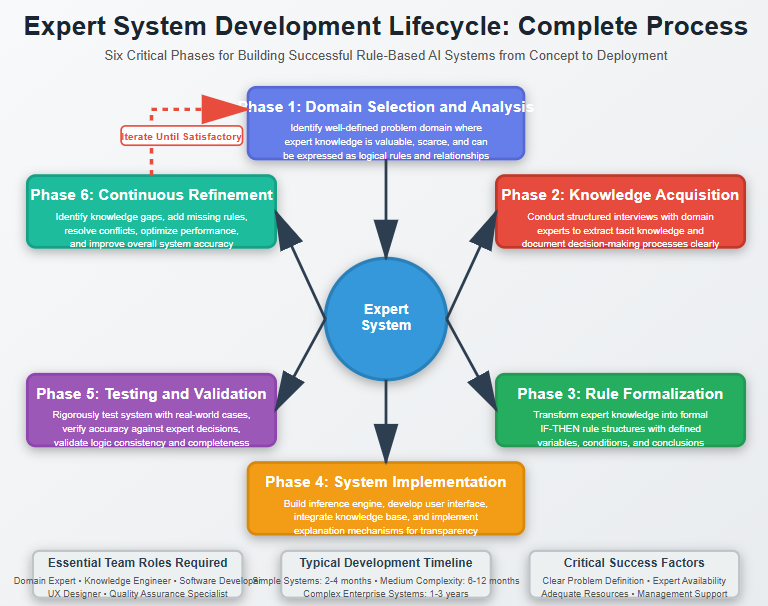
Step-by-Step Expert System Development Workflow and Implementation Process
Building an expert system follows a clear process. Here is how professionals do it:
Step 1: Pick the Right Problem
Choose a problem where expert knowledge is valuable but hard to find. The problem should involve logical rules, not creative thinking or physical skills. Good examples: medical diagnosis, equipment troubleshooting, loan approval. Bad examples: writing poetry, playing sports, creating art.
Step 2: Learn from Experts
Interview experts in the field. Watch them solve problems. Ask them to explain their thinking. Often, experts make decisions based on experience they cannot easily put into words. You need to observe patterns in how they work and convert those patterns into rules.
Step 3: Write Down the Rules
Convert expert knowledge into IF-THEN rules. Define all the terms clearly. If two experts disagree, you need to decide which rule to use or create rules that handle both approaches.
Step 4: Choose How to Reason
Decide whether to use forward chaining, backward chaining, or a mix. Build or choose software that implements this reasoning method.
Step 5: Test and Improve
Run the system on real cases. Compare its answers to what human experts would say. Find gaps where the system lacks knowledge and add new rules. This step repeats many times.
Historical Expert Systems That Transformed Their Industries
MYCIN: Pioneering Medical Diagnosis Through Rule-Based Reasoning
MYCIN was built at Stanford University in the 1970s. It diagnosed blood infections and recommended antibiotics. The system used about 600 rules from infectious disease specialists.
In tests, MYCIN performed as well as human doctors. What made MYCIN special was that it could handle uncertainty. Instead of saying “this is definitely true,” rules could say “this is probably true with 80% confidence.” The system tracked these confidence levels through chains of reasoning.
How MYCIN Worked: Real Example
Patient Information: Fever of 39.2 degrees, high white blood cell count, harmful bacteria found in blood, patient has normal immune system
MYCIN’s Thinking: The system checked rules about fever, lab results, and patient health. It calculated high probability of a serious blood infection. Based on the type of bacteria, it considered which specific germs were most likely.
Recommendation: Give gentamicin 1.5 mg per kg body weight every 8 hours plus ceftriaxone 1g every 12 hours. Watch kidney function carefully.
Explanation Given: MYCIN showed which rules led to this conclusion. It explained why these specific antibiotics were chosen based on the bacteria type and how these medicines work.
MYCIN never made it to actual hospitals due to regulatory issues and difficulties connecting it to hospital computer systems. But it proved that computers could match specialist doctors in narrow medical areas. The project influenced how we build medical software today.
DENDRAL: Automated Scientific Discovery in Molecular Structure Analysis
DENDRAL helped chemists figure out molecular structures. When you analyze an unknown chemical, instruments produce data about its mass and how it breaks apart. DENDRAL took this data and proposed what the molecule might look like.
The system knew chemistry rules about how molecules break apart. It generated possible structures that matched the data, then ranked them by likelihood.
How DENDRAL Solved a Chemistry Problem
Input: Mass spectrometry data showing main peak at 88 with fragments at 73, 58, and 43
DENDRAL’s Process:
1. Calculate possible molecular formulas for mass 88 (maybe C4H8O2)
2. Generate all possible structures with 4 carbons, 8 hydrogens, 2 oxygens
3. Predict how each structure would break apart in the instrument
4. Compare predictions to actual data
Answer: Most likely structure is ethyl acetate
Why: Loss of 15 units creates the 73 fragment (losing a methyl group). Loss of 30 units creates the 58 fragment. The 43 fragment matches a common breakdown product.
DENDRAL showed that computers could help scientists do research, not just calculate numbers.
XCON: Business Process Automation Through Configuration Expertise
Digital Equipment Corporation used XCON to automatically configure computer systems. When customers ordered VAX computers, someone had to pick compatible parts for processor, memory, storage, and accessories. Parts had to fit physically and work together electrically.
XCON contained thousands of rules from experienced configuration specialists. Before XCON, about 35% of configurations had errors. After XCON, errors dropped below 2%.
The Problem
Manual configuration took 5 to 8 hours per order. Specialists made frequent mistakes because product specifications changed constantly and compatibility rules were complex.
What XCON Did
Checked that parts worked together, arranged components in equipment racks, designed panel layouts, and created step-by-step assembly instructions for factory workers.
Business Results
Handled 80% of orders automatically. Saved millions of dollars yearly through fewer errors, faster processing, and reduced support calls.
The Challenge
Required adding 40 to 50 new rules every month as products changed. Maintaining thousands of rules required dedicated staff, showing the limits of pure rule-based systems.
Building Your Own Functional Expert System: Interactive Tutorial
Let me show you how to build a working expert system. We will create a laptop troubleshooting system that diagnoses common problems.
Selecting a Suitable Problem Domain for Rule-Based Implementation
For learning, pick a problem where:
You can define clear answers: Diagnosing laptop problems gives definite conclusions like “battery failed” or “hard drive crashed.” Vague problems like “recommend a laptop” involve too many personal preferences.
You can write 15 to 30 rules: This is enough to learn how systems work without getting overwhelmed.
You can create test cases: You need realistic examples to verify your system works correctly.
Developing a Comprehensive Rule Set for Laptop Troubleshooting
Here are the rules for our laptop diagnostic system. Each rule connects symptoms you observe to possible causes or next steps:
Building a Basic Inference Engine with Python Code
Now let me show you the reasoning engine. This code checks which rules match the symptoms and draws conclusions:
How This Code Works
add_fact: Stores symptoms you observe (like “no_lights” or “excessive_heat”)
check_conditions: Looks through all your facts to see if a rule’s conditions are met
forward_chain: Goes through each rule and fires the ones whose conditions match your facts
explain: Shows you which rule led to each conclusion so you understand the reasoning
Running Your Expert System with Real Examples
Let me show you how to use this system to diagnose a laptop problem:
Output from This Example
Problem: display_failure
Confidence: 80%
Action: test_external_monitor
Explanation: I reached this conclusion because Rule R2 was triggered by: power_button_pressed, lights_on, no_display
Interactive Laptop Troubleshooting System
Try this working expert system. Answer the questions and see how it diagnoses the problem:
Laptop Diagnostic Expert System
Question 1: When you press the power button, what happens?
Practical Applications of Expert Systems in Today’s Technology
Even though expert systems are old technology, they still solve important problems in many industries. They work best when rules are stable and need to be followed exactly.
Healthcare and Medical Decision Support Systems
Hospitals use expert systems to help doctors make safer decisions. These systems check for dangerous drug interactions, suggest diagnostic tests based on symptoms, and flag abnormal lab results.
Real Example: Drug Interaction Checker
When a doctor prescribes medicine, the system checks it against all other medicines the patient takes. If there is a dangerous combination, it alerts the doctor immediately. For instance, certain blood pressure medicines should not be mixed with some antibiotics. The system knows thousands of these interactions and checks them in seconds.
Banking and Financial Services Risk Management
Banks combine machine learning with rule systems. Machine learning spots unusual patterns that might be fraud. But rules enforce regulations that must never be broken.
For example, anti-money laundering rules require banks to report transactions above certain amounts. A pure machine learning system might miss these because it focuses on patterns, not absolute thresholds. Rules guarantee compliance.
Manufacturing Quality Control and Fault Diagnosis
Factories use expert systems to diagnose equipment problems. When a machine starts behaving strangely, the system asks operators specific questions and suggests causes based on symptoms.
Quality inspection systems check if products meet specifications. They apply rules about measurements, appearance, and performance. If something fails a rule, it gets flagged for review.
Information Technology Support and Configuration Tools
IT support chatbots use rule systems for common problems. They follow troubleshooting trees just like human support staff would. This handles routine issues automatically, freeing humans for complex problems.
Configuration tools ensure system settings are correct. When setting up a new server, the system applies rules about security, performance, and compatibility to prevent mistakes.
| Industry | How Expert Systems Help | Why Rules Work Better Than ML Here |
|---|---|---|
| Healthcare | Drug interaction warnings, clinical guidelines | Medical rules are strict and must be explainable. Cannot risk wrong answers. |
| Banking | Regulatory compliance, loan approval criteria | Laws require following exact rules. Need clear audit trails. |
| Manufacturing | Equipment diagnostics, quality standards | Safety rules must never be broken. Explanations needed for failures. |
| IT Support | Troubleshooting guides, system configuration | Proven solutions exist for common problems. No need to learn from data. |
Why Expert Systems Declined in Popularity
Expert systems dominated AI research in the 1980s but faced serious problems that limited their success.
The Knowledge Acquisition Bottleneck
Getting knowledge from experts took enormous time and effort. Experts struggled to explain their intuitive decisions as explicit rules. A single expert system might require hundreds of hours of interviews.
Worse, experts often disagreed with each other. Reconciling different expert opinions into consistent rules proved extremely difficult.
Rule Explosion and Maintenance Nightmares
Simple problems needed a few dozen rules. Real-world problems needed thousands. Managing that many rules became impossible.
Remember XCON, the computer configuration system? It needed 40 to 50 new rules added every month as products changed. A team of knowledge engineers worked full-time just keeping the rules updated. When rules interact in complex ways, changing one rule might break ten others.
Real Company Example
A large insurance company built an expert system for claim processing in the early 1990s. Within three years, the system had over 5,000 rules. When insurance regulations changed, updating the system took six months and cost hundreds of thousands of dollars. Eventually, they abandoned the system because maintenance became too expensive.
Cannot Handle Uncertainty Well
Real-world problems involve incomplete information and uncertainty. Expert systems struggled with this. Even systems that used confidence factors, like MYCIN, had limitations.
Machine learning systems naturally handle uncertainty because they work with probabilities. They can say “I am 73% confident” based on statistical patterns. Expert systems had to have explicit rules for every situation, including uncertain ones.
Cannot Learn from Experience
Expert systems never improved on their own. Every bit of knowledge had to be manually programmed. If the system made mistakes, someone had to write new rules to fix them.
Machine learning systems improve automatically as they see more examples. Feed them more data and they get better. This fundamental limitation made expert systems impractical for problems where knowledge changed rapidly or where learning from examples was easier than writing rules.
What Expert Systems Taught Modern AI Development
Although expert systems declined, they taught us valuable lessons that shape AI today.
The Critical Importance of Explainable AI
Expert systems always explained their reasoning. This transparency mattered in medicine, finance, and law where people needed to understand and verify decisions.
Modern machine learning often acts as a black box. You feed in data and get predictions, but the system cannot explain why. This creates problems in high-stakes applications.
Today, researchers work on “explainable AI” that combines machine learning’s power with expert systems’ transparency. The goal is systems that both learn from data and explain their reasoning clearly.
Hybrid Approaches Combining Rules and Machine Learning
The best modern systems mix both approaches. Use machine learning for pattern recognition and predictions. Use rules for constraints that must never be violated and for encoding domain knowledge that is too sparse to learn from data.
Hybrid System Example: Fraud Detection
Machine Learning Component: Analyzes transaction patterns to spot unusual behavior. Learns what normal looks like for each customer.
Rule-Based Component: Enforces absolute limits (transactions over $10,000 require extra verification). Checks regulatory requirements. Blocks transactions from banned countries.
Why This Works: ML catches new fraud patterns that rules miss. Rules prevent false positives and ensure compliance. Together they are stronger than either alone.
Knowledge Representation Methods That Influence Modern AI
Expert systems pioneered ways to represent knowledge in computers. Modern AI systems still use these concepts:
Semantic networks: Showing how concepts relate to each other. Knowledge graphs used by Google and other search engines evolved from this.
Ontologies: Formal definitions of concepts and relationships in a domain. Medical AI systems use ontologies to understand disease relationships.
Production rules: Still used in business rule engines that process insurance claims, approve loans, and route customer support tickets.
Building a Simple Real-World Expert System Project
Want to build your own expert system from scratch? Here is a complete roadmap.
Project Planning and Scope Definition
Start small. Pick a domain where you have personal expertise or easy access to an expert. Good beginner projects:
- Plant disease diagnosis based on visible symptoms
- Home appliance troubleshooting guide
- Personal finance decision helper
- Recipe recommendation based on available ingredients
- Study schedule planner based on courses and deadlines
Knowledge Gathering and Rule Development
Write down 20 to 30 rules that cover common cases. Use this template:
Test your rules by walking through examples manually. Make sure rules do not contradict each other.
Implementation Using Python or JavaScript
You have two good options:
Python: Better for standalone applications and systems that process data. Easier to add machine learning later if needed.
JavaScript: Better for web-based tools that anyone can use in their browser. Makes it easy to create interactive interfaces.
Adding User Interface and Explanation Features
Create a simple question-and-answer interface. After each answer, show which rules are being considered. When reaching a conclusion, display:
- The final diagnosis or recommendation
- Confidence level
- Which rules led to this conclusion
- What facts from the user triggered those rules
- Alternative possibilities if confidence is not high
Testing and Validation Process
Create at least 10 test cases covering:
- Common situations your system should handle easily
- Edge cases where rules might conflict
- Cases where not enough information is available
- Situations that should trigger multiple rules
If possible, have someone knowledgeable in the domain test your system and provide feedback.
Practical Takeaways and Modern Relevance
Expert systems represent an important chapter in AI history that still matters today. Here is what you should remember:
When to Use Expert Systems
Choose rule-based systems when you need transparency, have clear rules to follow, and changes happen slowly. Perfect for regulatory compliance, safety-critical systems, and encoding expert knowledge.
When to Use Machine Learning
Choose ML when patterns are complex, you have lots of data, rules are hard to articulate, or the environment changes rapidly. Great for prediction, pattern recognition, and personalization.
When to Use Both
Hybrid systems give you the best of both worlds. Use ML for flexibility and learning, rules for safety and compliance. Most production AI systems today are hybrids.
Key Lesson for AI Developers
Not every problem needs deep learning. Sometimes simple rules work better. Understanding expert systems helps you recognize when complexity is unnecessary and choose the right tool for each job.
Take Action: Build Your Own Expert System
The best way to understand expert systems is to build one. Start with the laptop troubleshooting example in this article. Modify it for a domain you know well.
Challenge yourself: Can you build an expert system that solves a real problem in your life or work? Even a simple system with 15 rules can be genuinely useful.
Next Steps
1. Pick a problem domain you understand well
2. Write down 15 to 20 rules on paper first
3. Implement the inference engine from this article
4. Add your rules to the system
5. Test it with real scenarios
6. Share it with others and get feedback
Expert systems may seem old-fashioned compared to neural networks and deep learning. But they teach fundamental concepts about knowledge representation, logical reasoning, and explainable decision-making. These concepts remain essential as we build the next generation of AI systems that people can understand and trust.
The future of AI is not choosing between rules and learning, but intelligently combining both approaches to create systems that are powerful, transparent, and aligned with human values.
External Resources
| S.No | Title & Description | Link |
|---|---|---|
| 1 | Expert system — Britannica article — a concise, authoritative overview of what expert systems are, their components (knowledge base & inference engine), and their historical origin. | https://www.britannica.com/technology/expert-system |
| 2 | What Is an Expert System? — TechTarget — a clear modern-AI friendly explanation of expert systems, how they work (forward/backward chaining), use cases, advantages and limitations. | https://www.techtarget.com/searchenterpriseai/definition/expert-system |
| 3 | Expert Systems in AI — GeeksforGeeks — a practical yet technical walkthrough of expert-system fundamentals, architecture, types, and real-world applications. Good for readers who want bridging theory and implementation. | https://www.geeksforgeeks.org/artificial-intelligence/expert-systems/ |
| 4 | Expert Systems — Encyclopedia.com — a historical overview tracing the evolution from early systems like DENDRAL to widespread adoption in industry, with discussion of strengths and limitations. | https://www.encyclopedia.com/science-and-technology/computers-and-electrical-engineering/computers-and-computing/expert-systems |
| 5 | “Foundations of Explainable Knowledge-Enabled Systems” (arXiv 2020) — a modern academic paper showing how explainability (a core strength of expert systems) remains relevant, bridging historical expert systems and modern explainable AI. | https://arxiv.org/abs/2003.07520 |
FAQs on Expert Systems
Are expert systems still used in real-world applications today?
Yes. Expert systems are actively used in industries where rules must be followed exactly and decisions must be fully explainable. Examples include drug interaction checking in hospitals, regulatory compliance in banking, equipment fault diagnosis in manufacturing, and IT troubleshooting systems. They are especially valuable where safety, law, or accountability is involved.
What is the biggest difference between an expert system and machine learning?
The main difference is how knowledge is created. In expert systems, humans explicitly write the rules. In machine learning, the system learns patterns automatically from data. Expert systems are always explainable, while machine learning models can behave like black boxes. Expert systems follow strict logic, while machine learning works with probabilities.
Can expert systems learn and improve on their own?
No. Traditional expert systems do not learn automatically. Every improvement requires a human to add or modify rules. This is one of their biggest limitations. That is why modern AI systems often combine expert system rules with machine learning models that can learn from data over time.
When should I choose an expert system instead of machine learning?
You should choose an expert system when the rules are clear, explainability is mandatory, data is limited, and decisions must strictly follow regulations or safety constraints. Examples include legal compliance checks, safety monitoring, medical guidelines, and financial rule enforcement.
Is it possible to combine expert systems with modern AI?
Yes. Many modern production systems use a hybrid approach. Machine learning handles prediction and pattern detection, while expert system rules enforce safety limits, legal constraints, and business policies. This combination gives both flexibility and control, making AI systems safer and more reliable.


Leave a Reply