Rise of Neural Networks: Historical Evolution Practical Understanding and Future Impact on Modern AI Systems

Rise of Neural Networks: Historical Evolution Practical Understanding and Future Impact on Modern AI Systems

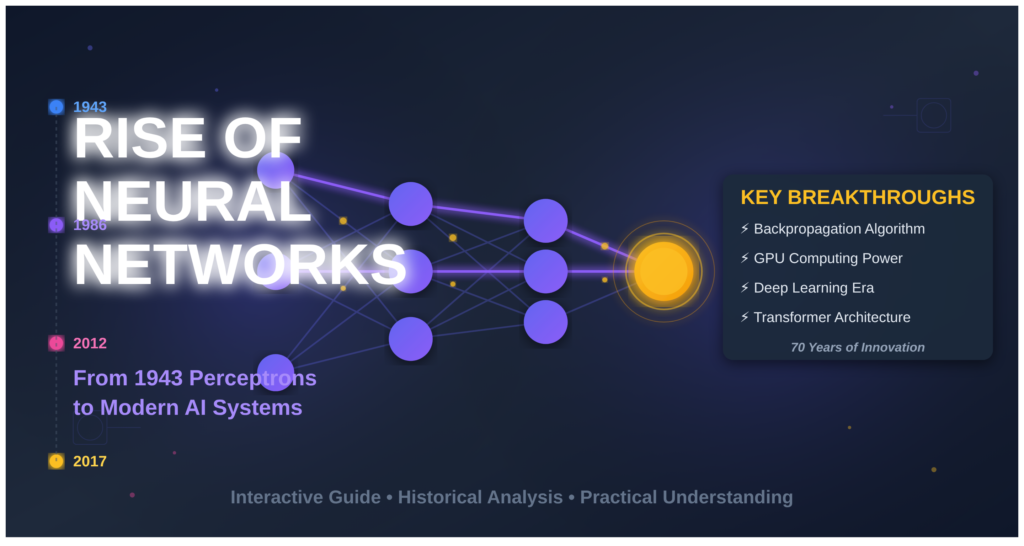
The journey from simple perceptrons to systems that generate images and write code took 70 years. This path was not smooth. Neural networks experienced crushing failures, funding freezes, and near-complete abandonment before transforming artificial intelligence. Most articles celebrate recent wins. They skip the decades when neural networks were considered a dead end. But those failures contain the most valuable lessons about how machine learning actually works. This article explores why understanding the 1969 perceptron collapse matters more than knowing about GPT. How a forgotten 1974 PhD thesis unlocked modern deep learning. Why GPUs changed AI more than better algorithms. And what the three major boom-bust cycles teach us about building AI systems that actually work.
AI Winter Explained: How Funding Cuts, Failed Promises, and Market Shifts Shaped the Future of Artificial Intelligence

AI Winter Explained: How Funding Cuts, Failed Promises, and Market Shifts Shaped the Future of Artificial Intelligence

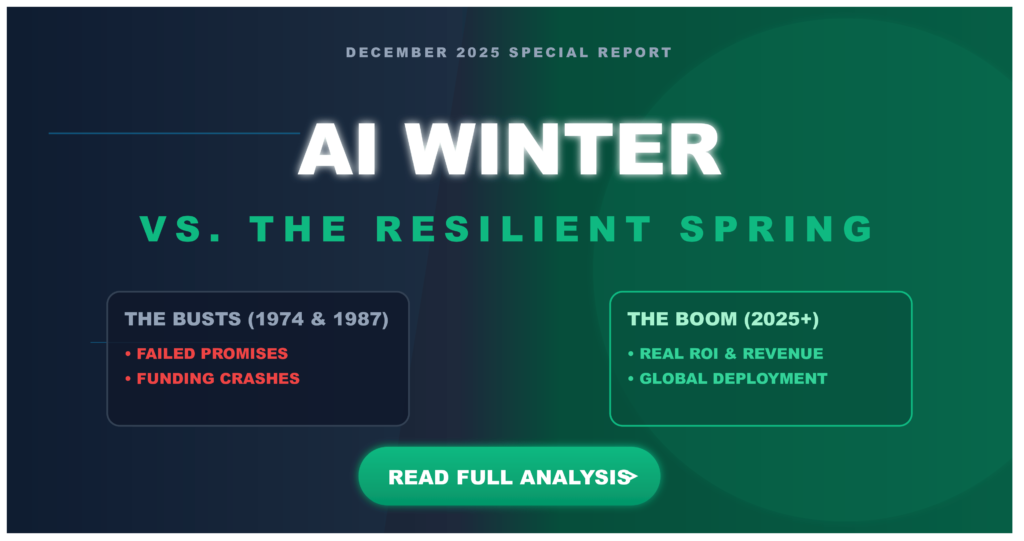
In 1973, the British government asked physicist James Lighthill to review progress in artificial intelligence research. His report concluded that researchers had not achieved their stated objectives. Within a year, UK funding for AI research dropped sharply. Many programs closed. This pattern repeated across multiple countries between 1974 and 1980, then again from 1987 to 1993. Researchers coined the term “AI Winter” to describe these periods when funding dried up, companies failed, and the field nearly disappeared. Understanding what happened helps you make informed decisions about AI careers, business investments, and technology adoption today.
Expert Systems: A Complete Guide

Expert Systems: A Complete Guide

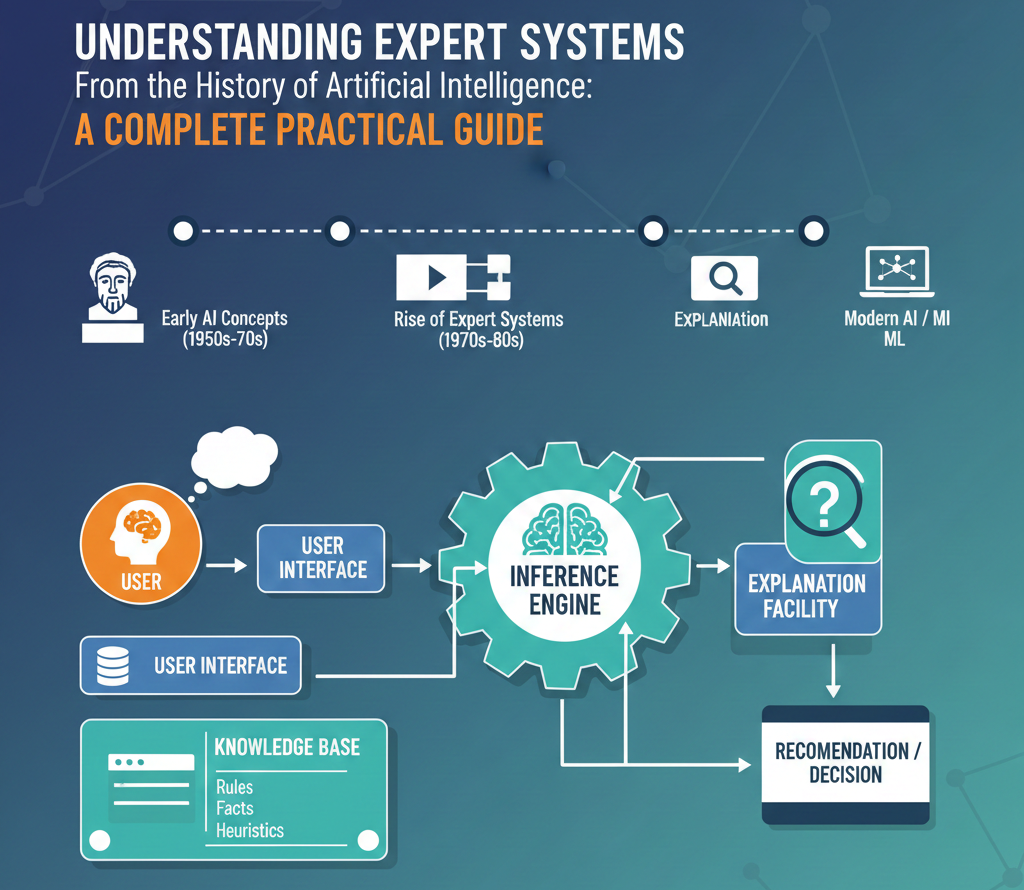
Expert systems came before neural networks. They worked by storing knowledge from human experts as simple rules. Think of them like a digital version of an instruction manual written by the best professionals in a field. Here is the big difference: Expert systems use clear rules that humans write down. Modern machine learning finds patterns in data automatically. Neither approach is always better. The right choice depends on your specific problem. Why should you care about expert systems today? Because they solve real problems that machine learning cannot handle well. Banks use rule systems to follow government regulations. Hospitals use them to check if prescribed medicines might interact badly. These systems need to explain their decisions clearly, which expert systems do very well.
The 1956 Dartmouth Workshop: How a Summer Workshop Defined Artificial Intelligence

The 1956 Dartmouth Workshop: How a Summer Workshop Defined Artificial Intelligence

The Dartmouth Summer Research Project on Artificial Intelligence wasn’t just another academic conference. It was the moment when scattered ideas about thinking machines coalesced into a unified field of study. For the first time, researchers had a name for what they were pursuing: Artificial Intelligence. For students diving into machine learning , researchers exploring neural networks, or anyone curious about how Siri understands your voice—understanding Dartmouth is understanding AI’s DNA. Every algorithm, every breakthrough, every debate about AI ethics traces back to the questions asked in that small New Hampshire college during the summer of 1956.
The Engineering History of AI: Why Modern Systems Fail in Predictable Ways

The Engineering History of AI: Why Modern Systems Fail in Predictable Ways

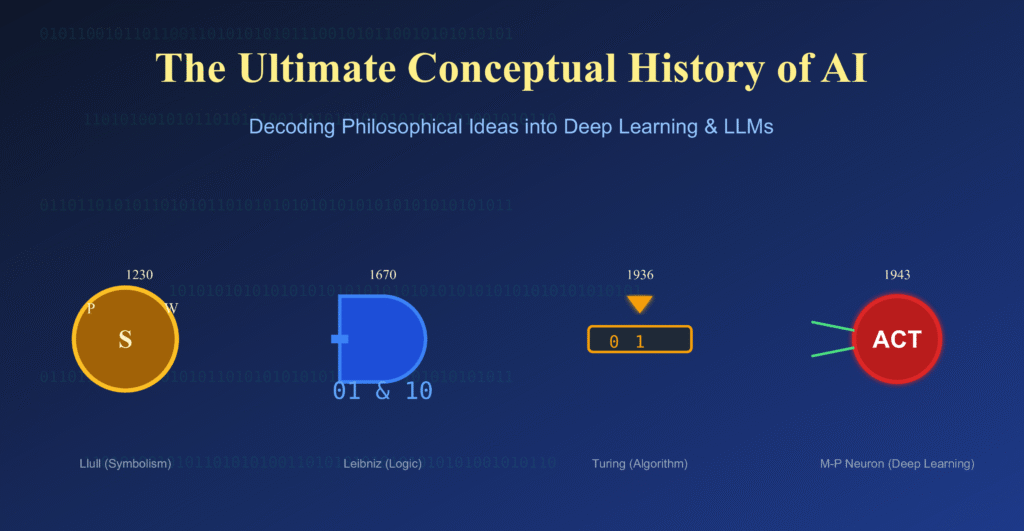
The journey of Artificial Intelligence is far older than the modern computer. To truly understand today’s advanced systems, from Machine Learning algorithms to LLMs, you must trace the intellectual history back to four core, authentic concepts. These pillars are the foundational DNA: Symbolism (Llull): Turning ideas into manipulable tokens. Logic (Hobbes/Leibniz): Reducing thought to pure binary calculation. Algorithm (Turing): Defining the universal recipe for computation. Activation (McCulloch-Pitts): Modeling the biological decision unit. Every concept below is explained with a unique, interactive demo, ensuring you learn by doing and make a deeper connection with the material.
Interactive Introduction to AI: Machine Learning, Neural Networks & Supervised Learning for Beginners

Interactive Introduction to AI: Machine Learning, Neural Networks & Supervised Learning for Beginners

Forget everything you think you know about AI articles. We’re not starting with definitions or history. Instead, you’re going to BE the AI for the next few minutes. Look at this pattern. Three shapes are given, and one is missing. Can you identify the alternating color and shape pattern and click the correct answer?
Top 8 Hidden Python Libraries for Machine Learning That Will Supercharge Your Models

Top 8 Hidden Python Libraries for Machine Learning That Will Supercharge Your Models

Python is the top choice for machine learning because it has so many useful libraries. You’ve probably heard of TensorFlow, PyTorch, and Scikit-learn—they’re the most popular ones. But did you know there are lesser-known libraries that can make machine learning even faster, easier, and more powerful? These hidden tools can save you time, improve your models, and simplify complex tasks. In this post, we’ll share top 8 hidden Python libraries that can boost your machine learning projects and help you work smarter. Let’s get started!
How to Design and Implement a Multi-Agent System: A Step-by-Step Guide

How to Design and Implement a Multi-Agent System: A Step-by-Step Guide

Multi-agent system (MAS) are a type of AI where multiple intelligent agents work together to complete tasks. These agents can communicate, make decisions, and solve problems as a team. Many industries use MAS to improve their work. For example: Self-driving cars use MAS to avoid traffic and prevent accidents. Banks and stock markets use MAS to analyze financial data and make better decisions. In this guide, you will learn how to build a multi-agent system step by step. We will use Python, LangGraph, and OpenAI to create a working system. By the end, you will have a fully functional MAS that you can use in real-world applications.