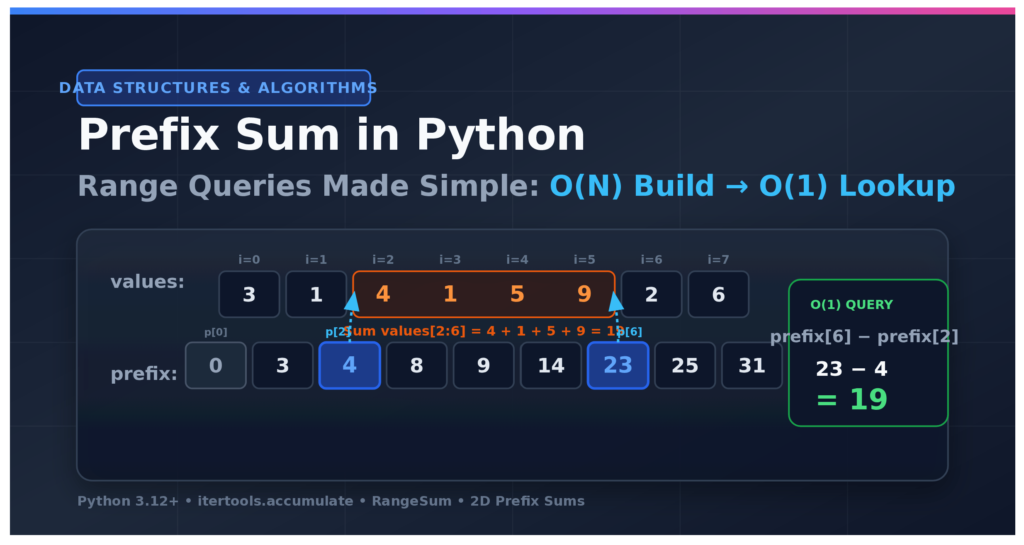
Prefix Sum in Python: This is the fourth article in the Arrays & Strings cluster. It builds on Sliding Window in Python: From Algorithm to Request Rate Limiter, so read…
Learn how to implement the sliding window technique in Python, from finding sums in arrays to building a time-based request rate limiter. Explore fixed-size and variable-size windows, process streaming data, solve string problems, and compare optimized solutions with brute-force approaches using tests and benchmarks.
Learn how to use two pointers in Python to solve array, string, and linked list problems efficiently. Explore three pointer patterns, worked examples, time complexity, common mistakes, and practice problems with solutions.
Learn Arrays in Python, understand common operations and their time complexity, compare Python lists with array.array and NumPy, and practice essential array patterns with practical DSA interview problems and solutions.
Learn amortized analysis in Python with practical examples of dynamic arrays, `list.append()`, and queues. Understand aggregate, accounting, and potential methods, with step-by-step explanations, code examples, and DSA interview questions.
Learn how to analyze the time and space complexity of Python algorithms by examining inputs, loops, conditionals, recursion, data structures, and hidden operation costs.
Recursion lets a function solve a problem by calling itself on a smaller version of that problem. This guide explains how recursive calls work, how Python’s call stack keeps track of them, why base cases matter, and how recursion affects time and space complexity. You’ll also see practical examples, common mistakes, recursion trees, and when a loop is the better choice.
Best-case complexity is an algorithm's performance on the most favorable input. Average case is its typical performance across realistic inputs. Worst case is its performance on the least favorable input. All three can be described using Big O notation, and interviewers usually expect worst case unless stated otherwise.
Big O notation helps you understand how efficiently an algorithm performs as your input grows. In this beginner-friendly guide, learn time and space complexity, common Big O types like O(1), O(log n), O(n), O(n log n), and O(n²), with practical Python examples, interview questions, and practice problems.
Data structures and algorithms with Python means learning to organize data efficiently (arrays, linked lists, trees, graphs, hash tables) and to process it efficiently (searching, sorting, recursion, dynamic programming) using Python. Together, they decide how well your code holds up as the data grows.