ML Production Readiness Checklist: 50 Things to Verify Before You Ship

ML Production Readiness Checklist: 50 Things to Verify Before You Ship

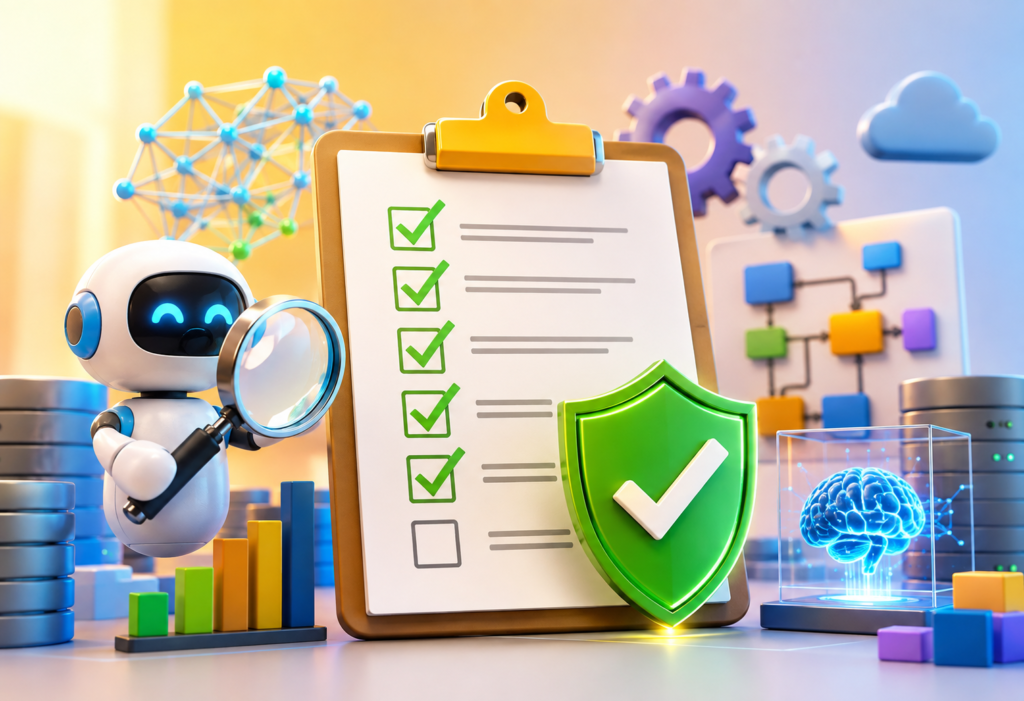
A production ML checklist is only useful if it can be run before deployment. This 50-item production readiness gate combines a dependency-free static scanner that automatically checks 20 items with 30 human sign-offs covering ownership, compliance, rollback rehearsal, monitoring, and operational readiness. Tested against two sample repositories, the scanner passed 19/20 checks on the production-ready project and just 1/20 on the deliberately underprepared one—showing exactly what automation can catch, and what still requires accountable human review.
ML Technical Debt: How to Identify, Measure, and Pay It Down

ML Technical Debt: How to Identify, Measure, and Pay It Down

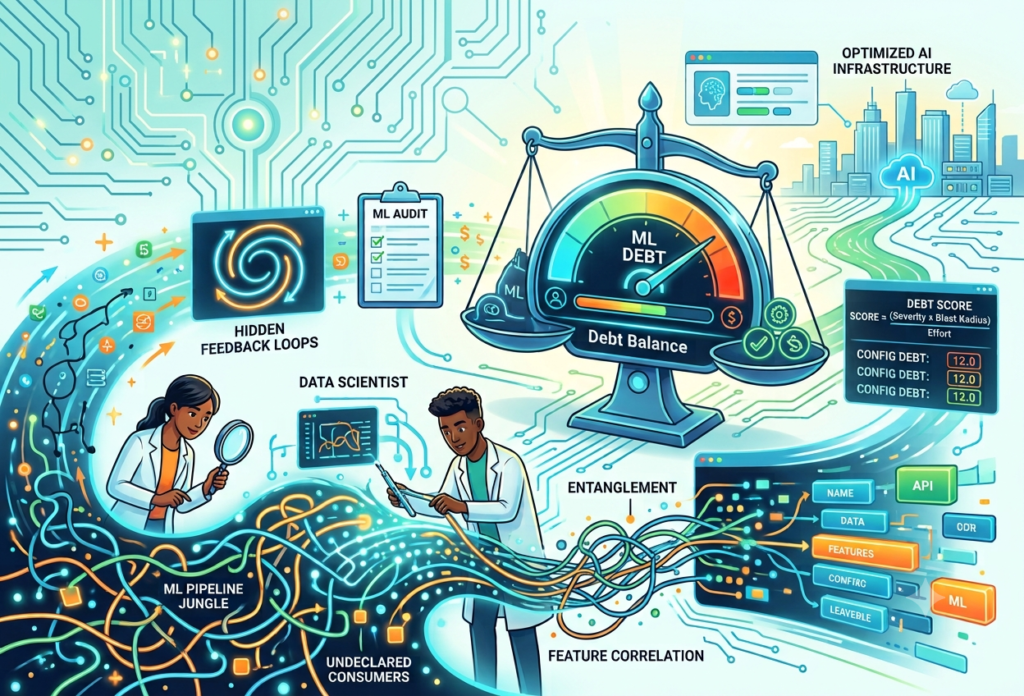
Machine-learning technical debt is different from ordinary software debt. It doesn't just make a codebase harder to maintain—it can actively change what a model does while the system is still running. A feature can disappear, a dependency can remain hidden, or a recommender can start feeding its own outputs back into its training data, all without an obvious failure in production. In this article, we put three of those failure modes through actual code: feature entanglement, hidden feedback loops, and undeclared consumers. The results are sometimes counterintuitive. Removing one correlated feature shifted the remaining model coefficients by 110.1% on average, even though predicted probabilities moved only slightly. A purely greedy recommender showed just 12 of 200 items across 60 rounds and had 0/10 overlap with the true top-10. And a characterization test caught a seemingly harmless refactor that silently changed 58.68% of one column's values, producing 2,934 unexpected NaNs. The lesson is simple: an ML system can continue to run, score well, and pass code review while its underlying behavior and dependencies are quietly changing. The safest way to manage that debt is to make those changes observable—with explicit interfaces, static audits, characterization tests, and a practical framework for prioritizing what to fix first.
How to Debug ML Inference Latency and Throughput Issues

How to Debug ML Inference Latency and Throughput Issues

Most “why is my model slow” investigations start with guesswork instead of measurement. This article replaces that with a structured diagnostic workflow built on real benchmarks from a misbehaving production-like system. By isolating each stage of inference—preprocessing, batching, model execution, and postprocessing—it shows that the model itself is rarely the bottleneck. Across repeated experiments, batching delivered up to 8.4× speedups, while seemingly obvious optimizations like quantization produced inconsistent results depending on system noise. ONNX Runtime emerged as the most reliable performance gain, while pruning failed to improve latency on dense CPU workloads. The deeper lesson is not which technique is fastest, but why single-run averages can mislead and why p50 metrics, repeated measurements, and controlled testing matter more than assumptions. If you are debugging slow ML inference, this is not a list of tricks—it is a process for finding the real problem before you try to fix it.
Shadow Deployment and Canary Testing for Machine Learning Models: A Practical Guide

Shadow Deployment and Canary Testing for Machine Learning Models: A Practical Guide

Learn how to implement shadow deployment and canary testing for machine learning models using Python. This practical guide shows you how to build a shadow router, create a deterministic canary traffic splitter, compare models with McNemar's test and two-proportion z-tests, benchmark deployment latency, and design a statistically sound promotion gate. You'll also explore real production workflows, logging strategies, failure isolation, traffic rollout best practices, and how tools like Seldon Core, BentoML, and AWS SageMaker support safe model deployments. Whether you're deploying your first ML model or improving an existing MLOps pipeline, this tutorial provides production-ready techniques to validate new models with real traffic before a full rollout.
ML Model Monitoring: How to Detect Data Drift and Model Decay in Production

ML Model Monitoring: How to Detect Data Drift and Model Decay in Production

Most ML monitoring pipelines fail for a simple reason: they treat every alert the same. In production, a model can degrade for multiple reasons—data drift, concept drift, or even silent label shifts—and each requires a completely different response. Yet many systems rely on a single signal, triggering retraining without understanding the root cause. This article breaks down how models actually fail in the real world. Through controlled scenarios—stable streams, abrupt drift, gradual drift, and label shift—we show how common detectors like PSI, KS, MMD, and ADWIN behave under pressure. The results are counterintuitive: some methods fire too early, some too late, and some miss critical failures entirely. The key insight is simple: Monitoring is not about detecting change—it’s about diagnosing the type of change. A robust system combines feature-level signals, prediction monitoring, and delayed ground truth evaluation, aligned with the cadence of the domain. Because in production, a drift alert is not a retrain command—it’s the start of an investigation.
Retrain vs Fine-Tune vs Train from Scratch: A Decision Framework for ML Engineers

Retrain vs Fine-Tune vs Train from Scratch: A Decision Framework for ML Engineers

When a model starts drifting in production, the real question is not whether to retrain—it’s how. Most teams default to habit: fine-tune everything or rebuild everything from scratch. Both choices can be expensive mistakes. This article breaks that pattern. It turns retraining vs fine-tuning into a measurable decision problem based on drift signals, data availability, transfer quality, and sample size. Through four production scenarios—distribution shift, domain transfer, new class expansion, and stable updates—we compare head-only fine-tuning, full fine-tuning, retraining strategies, and training from scratch using real benchmark results. The outcome is a decision framework you can run in code, not intuition: when to freeze the trunk, when to update the full network, when to retrain on combined data, and when to start over entirely. By the end, the choice is no longer subjective. It becomes a system-level decision driven by drift, data, and cost constraints.
Continual Learning in PyTorch: A Practical Guide for ML Engineers

Continual Learning in PyTorch: A Practical Guide for ML Engineers

Most continual learning systems fail for a simple reason: they mix incompatible scenarios. Task, domain, and class incremental learning are not variations of the same problem—they require different architectures, metrics, and evaluation. This article breaks down the three settings, shows where methods fail, and backs every claim with real benchmark results.