
How to Prevent Catastrophic Forgetting in PyTorch (Complete Guide)

How to Prevent Catastrophic Forgetting in PyTorch (Complete Guide)

Production ML systems don’t fail loudly — they fail quietly, over time. In this article, I break down how continual learning helps models stay relevant in changing environments, and why most systems struggle once deployed. You’ll see the hidden gaps between training and real-world behavior, and how to design pipelines that adapt, learn, and improve continuously instead of degrading silently.
How to Detect and Fix Production Drift in Machine Learning (Complete Guide)

How to Detect and Fix Production Drift in Machine Learning (Complete Guide)

Production drift in machine learning is one of the most overlooked reasons why models fail in real-world systems. Even when evaluation metrics look perfect, changing data distributions can silently degrade performance over time. This guide explains how to detect, monitor, and fix production drift using practical diagnostics and proven techniques.
Why sorted() Is Safer Than list.sort() in Production Python Systems

Why sorted() Is Safer Than list.sort() in Production Python Systems

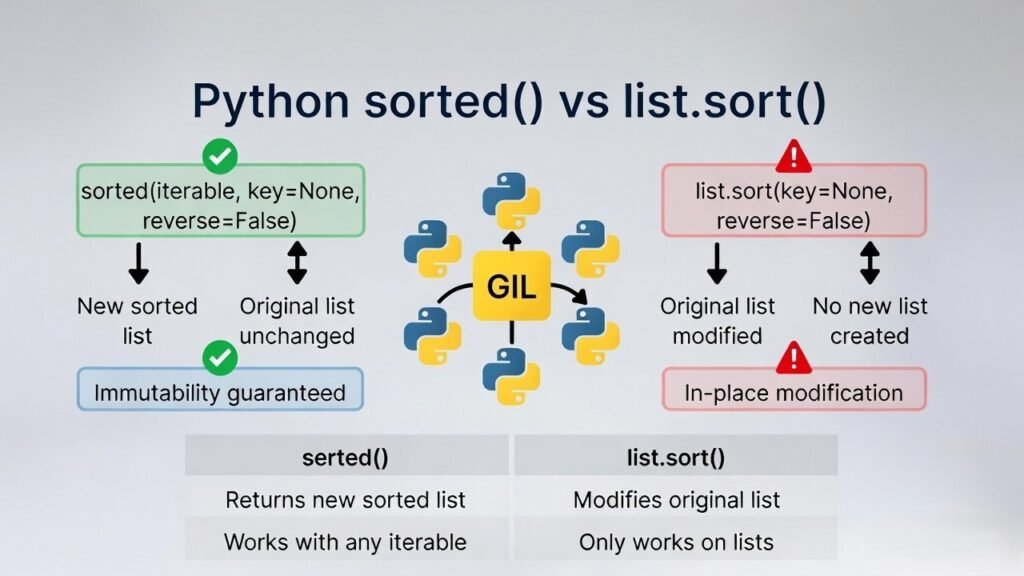
Most Python tutorials cover this in one sentence: sort() modifies the list in place and returns None; sorted() returns a new sorted list. That is accurate. But it leaves out the part that actually matters when you are writing a backend service. In a short script, the difference is cosmetic. In a service where functions share data — through caches, through parameters, through objects passed across layers — sort() creates a category of bug that is genuinely hard to find. Not because it is complicated, but because it does not crash. The data just looks slightly wrong, and you spend time looking in the wrong places. This article works through the mechanics: what Python does in memory when you call each function, what the GIL actually protects (and a common misconception about it), and a realistic incident pattern that shows how a single .sort() call can quietly corrupt shared state for weeks.