How to Write a Python Program to Find LCM

How to Write a Python Program to Find LCM

Finding the Least Common Multiple (LCM) is a fundamental mathematical operation that every Python programmer should master. Whether you’re preparing for coding interviews, competitive programming contests, or building real-world applications, understanding LCM calculation methods will give you a significant advantage. In this comprehensive tutorial, we’ll explore four different methods to calculate LCM in Python, each with its own benefits and use cases. You’ll also get hands-on practice with our interactive calculator and test your knowledge with a challenging quiz.
How to Set Up CI/CD for Your Python Projects Using Jenkins

How to Set Up CI/CD for Your Python Projects Using Jenkins

Let’s say you are writing a Python project. You write some code, save it, and then test it to make sure it works. But doing this every time can be boring and slow. What if a robot could do this for you? That’s what CI/CD does. What is CI/CD? CI/CD is short for: CI = Continuous Integration CD = Continuous Delivery Don’t worry about the big words. Here's what they really mean: CI means your code is automatically tested when you change it. CD means your code is automatically shared or deployed after it’s tested. So, instead of doing everything by hand, a computer can do it for you!
The Ultimate Guide to the range() Function in Python

The Ultimate Guide to the range() Function in Python

The range() function is one of Python’s most useful built-in functions. It helps you generate a sequence of numbers that you can use in loops, list comprehensions, and many other situations. If you’ve written any Python code with loops, you’ve probably used range() already! In this guide, you’ll master everything about the range() function, from basic usage to advanced techniques. You’ll also learn how it relates to other Python features like lists and functions. Bookmark this page for future reference!
How to compute factorial in Python

How to compute factorial in Python

Before we jump into coding, let's take a moment to understand what factorial means in mathematics. In simple terms, the factorial of a number (written as n!) is the product of all positive integers less than or equal to n. So, for example: 5! = 5 × 4 × 3 × 2 × 1 = 120 Factorials are very useful in various areas of mathematics, particularly in problems involving: Combinatorics (like permutations and combinations) Probability theory Algorithms dealing with large numbers and complex calculations Series expansions in calculus Discrete mathematics and computer science applications
How to Count the Digits in a Number Using Python

How to Count the Digits in a Number Using Python

Count the Digits in a Number Using Python: Let’s say you have a number—like 12345—and you want to know how many digits are in it. If you look at it yourself, it’s easy. You just count: 1, 2, 3, 4, 5. That’s 5 digits. But how do we make Python do that for us? In this guide, I’ll show you a few ways to count digits in a number using Python. You’ll learn: How to count digits by turning the number into a string How to count digits without turning it into a string and also learn How to use simple math to figure it out
How to Print Patterns in Python: Loops, Logic, and Code Examples

How to Print Patterns in Python: Loops, Logic, and Code Examples

Print Patterns in Python means writing code that prints shapes or designs using characters like Asterisk (*), numbers, or letters. You’ll often see patterns like triangles, pyramids, or diamonds. This kind of problem is very popular in coding interviews and beginner Python exercises because it helps you practice loops, understand logic flow, and get better at using Python print statements effectively. You’ll typically use: for loops – to repeat actions a set number of times. while loops – for more flexible repetition. Nested loops – a loop inside another loop, which is key to building multi-line patterns. Practicing these problems sharpens your logic and builds a strong foundation for solving Python loop problems later on.
AI Pulse Weekly: New Eyes, New Minds The Week AI Got Personal

AI Pulse Weekly: New Eyes, New Minds The Week AI Got Personal

This week, something important happened in the world of AI: it started to feel more personal Exclusively on AI Pulse Weekly. AI tools are no longer just answering questions or writing emails—they’re starting to understand us better, adapt to our needs, and fit into our daily lives in more meaningful ways. In this issue of AI Pulse Weekly, we explore the biggest updates from companies like Google, Meta, and OpenAI. Google is using its new Gemini AI to teach languages and challenge Duolingo. Meta has launched its own AI app to compete with tools like ChatGPT. Meanwhile, Sam Altman is rolling out eye-scanning ID tech that could change the way we prove who we are. We also look at how specialist AI tools—focused on one job—and generalist AIs—like ChatGPT—are taking different paths. Some tools are now combining both approaches to create smarter, more helpful assistants.
How to Use If-Elif-Else in Python (With Easy Code Examples)

How to Use If-Elif-Else in Python (With Easy Code Examples)

Let’s say your program needs to make a choice—something like, “If it’s raining, grab an umbrella. If it’s sunny, wear sunglasses. Otherwise, just go as you are.” In Python, we use if, elif, and else to handle exactly that kind of logic. These statements let your program make decisions based on conditions. So instead of running the same thing every time, it can react differently depending on what’s happening. In this guide, I’ll show you what these statements are, why they’re important, and how to use them with easy-to-follow examples. No confusing codes—just clear, simple steps to help you get the hang of it.
How to Write a Python Program for Geometric Progression Step-by-Step

How to Write a Python Program for Geometric Progression Step-by-Step

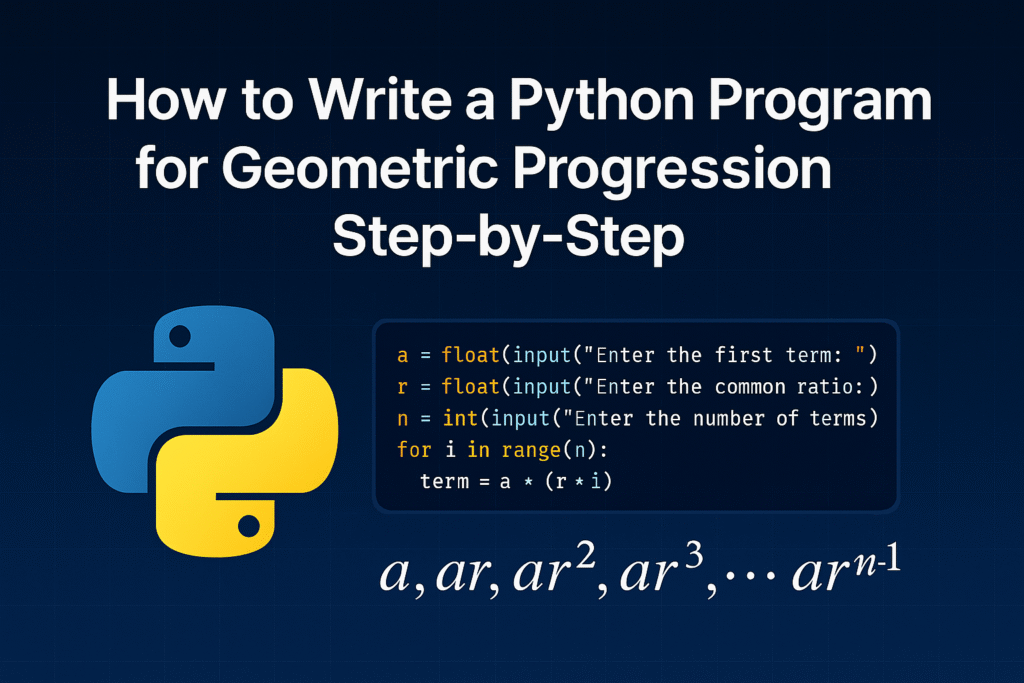
A geometric progression is just a sequence where each number is multiplied by the same value to get the next one. For example: 2, 4, 8, 16, 32... Here, we’re multiplying by 2 each time. Now instead of calculating each number by hand, wouldn’t it be easier to write a Python program that does it for you? That’s exactly what we’ll do—step by step.