

DSA with Python: Data Structures and Algorithms Complete Roadmap
Introduction
Have you ever frozen during a coding interview? Or watched your Python script crawl to a halt on a big file? Or opened a coding problem and had no idea where to even begin? If so, you’ve felt the same gap that most learners feel. That gap has a name: data structures and algorithms.
This guide is your starting point. It works whether you’re a self-taught developer prepping for interviews, a student trying to connect theory to real code, or an engineer who just wants to write faster software.
This guide is the pillar page, supported by 75 in-depth articles across 12 stages. One structured path from Python fundamentals to interview-ready DSA.
By the end, you’ll know what data structures and algorithms actually are. You’ll know why they matter outside of interviews. And you’ll know exactly what order to learn them in. This page is your map. Every stage below links out to a full, dedicated article, so use this guide to see the big picture and decide where to go next, not to learn each topic in depth.
This complete DSA roadmap with Python takes you from Big O and recursion through arrays, hashing, linked lists, trees, graphs, dynamic programming, and interview practice. Follow the stages in order or jump directly to the topic you need.
In Simple Terms
Think of it this way. A data structure is a container for your data, built with a specific purpose in mind. An algorithm is a set of steps for doing something with that data. Learning DSA with Python means learning how to pick the right container, and the right steps, so your code stays fast even when the data grows large.
At a Glance
- 12 learning stages, 75 supporting articles, from the basics of complexity to interview preparation
- What you need first: comfort with Python variables, loops, functions, and lists. No CS degree needed.
- How long it takes: with a few focused hours of practice a week, many learners build a solid foundation in roughly 2 to 4 months
- The real skill you’re building: spotting which tool fits a new problem, instead of memorizing answers
- Where to start: read Prerequisites if you’re newer to Python, or jump straight to Foundations
Recommended Path for Beginners
If you only take one thing from this page, take this order:
Python basics → Big O → Recursion → Arrays → Hashing → Linked Lists → Stacks & Queues → Binary Search → Trees → Graphs → Backtracking → Dynamic Programming → Interview Practice
Everything else on this page exists to support that path in more detail.
Prerequisites
You don’t need any DSA background to start here. But you do need to be comfortable with basic Python. Before you go further, check that you can:
- Use variables and basic types: numbers, strings, booleans
- Write loops, including a loop inside another loop
- Write functions, and understand what a return value is
- Create and loop through lists and dictionaries
- Break a word problem into steps before you start typing code
If any of these feel shaky, spend a week getting comfortable with them first. Everything below builds on this foundation. Skipping it doesn’t save time. It just moves the confusion to later.
What Are Data Structures and Algorithms in Python?
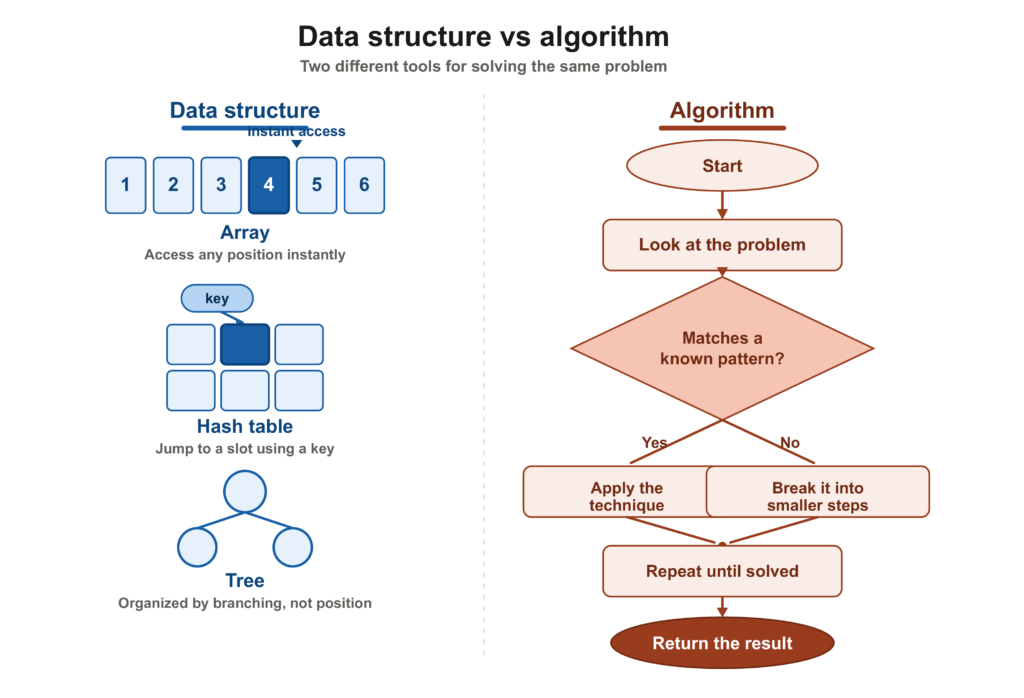
A data structure is a container with rules. Python’s list behaves much like a dynamic array: elements are stored in an indexed sequence, so accessing an element by position is typically O(1), similar to walking straight to a numbered locker instead of checking each one in order. A hash table holds labeled items, like a coat check with numbered tickets, so you can retrieve the right coat without checking every hook. A tree branches out, like a family tree. On its own, a tree doesn’t guarantee anything fast. Certain kinds of trees, like binary search trees and heaps, use that branching shape to make specific operations, such as searching or finding the most urgent item, efficient.
An algorithm is what you do with a container. Sorting a list, searching for a value, finding the shortest path between two points, or checking whether a sequence of parentheses is balanced are all algorithms. The same algorithm can behave very differently depending on which data structure backs it, which is why the two are always taught together.
Neither exists in isolation in real code. Choosing a hash table over an array can turn a slow, item-by-item lookup into a near-instant one. Choosing the wrong data structure for a graph problem can turn a solvable problem into one that times out.
Why Learn DSA with Python?
Python isn’t the fastest language out there. But it’s one of the easiest to learn DSA with, for a few simple reasons:
- The syntax gets out of your way. You focus on the idea, not on fighting the language.
- Python already has the building blocks. Lists, dictionaries, sets, and tuples map directly onto the concepts you’re about to learn.
- The standard library saves you time. Modules like
collectionsandheapqgive you ready-made queues and heaps, so you spend your energy on the logic, not the plumbing. - Interviews accept it. Most companies let you use Python in technical interviews, so what you practice here is what you’ll actually use.
Data Structures vs Algorithms: What’s the Difference?
Here’s a simple way to keep the two apart before you start combining them.
| Data Structure | Algorithm | |
|---|---|---|
| What it is | A way to organize and store data | A set of steps to solve a problem |
| Examples | Array, linked list, stack, queue, hash table, tree, graph, heap | Binary search, merge sort, BFS, DFS, dynamic programming |
| The question it answers | “How is this data arranged?” | “What do I do with this data?” |
| Everyday version | A filing cabinet | The method you use to find one file inside it |
You almost never judge one without the other. When someone asks “what’s the best way to solve this?”, they’re really asking which container and which steps work best together.
What Is Big O Notation?
Big O notation tells you how much slower an algorithm gets as you feed it more data. Double the input on an “O(n)” algorithm, and the work roughly doubles too. Double it on an “O(n²)” algorithm, and the work roughly quadruples.
| Complexity | What it means |
|---|---|
| O(1) | Constant — the input size doesn’t change the amount of work |
| O(log n) | Logarithmic — the problem gets cut down repeatedly, like binary search |
| O(n) | Linear — the work grows in direct proportion to the input |
| O(n log n) | Common in efficient sorting algorithms |
| O(n²) | Quadratic — often comes from a loop nested inside another loop |
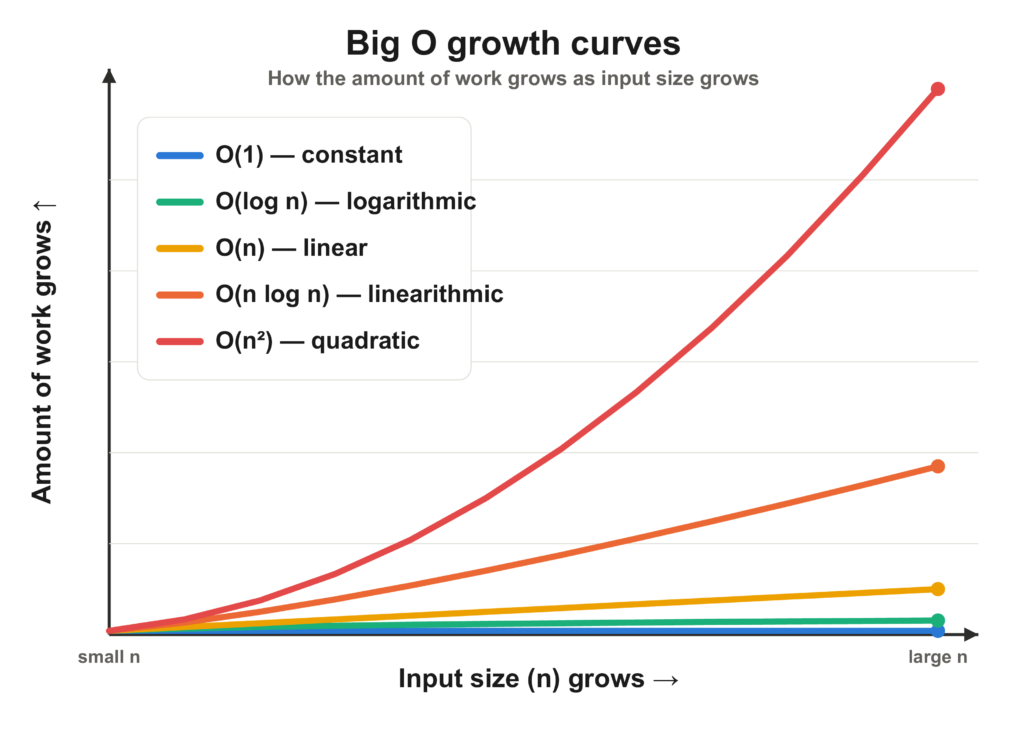
On a tiny input, the difference may barely matter. As the input grows, however, the gap between these complexity classes can become enormous, though the exact runtime always depends on the implementation, the operation, and the hardware it runs on.
Want the full picture, including how to calculate it and the most common mistakes? → What Is Big O Notation? Time and Space Complexity Explained
Quick Complexity Reference
A few common operations you’ll run into constantly across this series:
| Operation | Typical Complexity |
|---|---|
| List indexing | O(1) |
| List append | O(1) amortized |
| List search | O(n) |
| Dictionary lookup | O(1) average |
| Set lookup | O(1) average |
| Binary search | O(log n) |
| Sorting | O(n log n) typical |
Each of these gets its own detailed explanation in the relevant stage below.
The Complete Data Structures and Algorithms Roadmap with Python
Here’s the order we recommend learning data structures and algorithms with Python, broken into 12 stages backed by 74 articles. You don’t have to follow it exactly, but each stage leans on the one before it, so skipping ahead usually means backtracking later.
1. Foundations & Complexity
Before you touch a single data structure, you need a way to judge how fast your code runs and a way to break a big problem into smaller ones.
- Start here: What Is Big O Notation? → Recursion in Python
- Go deeper: Best, Average, and Worst-Case Complexity → How to Analyze the Time and Space Complexity of an Algorithm → Amortized Analysis in Data Structures
- Stage goal: measure how fast an algorithm is, understand recursion, recognize when a problem can be expressed recursively, and analyze the time and space it uses.
2. Arrays & Strings
Python’s list is your everyday array, and it’s usually where people write their first real algorithm.
- Start here: Arrays in Python → Two Pointers in Python → Sliding Window Technique in Python
- Go deeper: Prefix Sum in Python → String Algorithms in Python → Difference Arrays in Python → Kadane’s Algorithm → Array Manipulation Patterns
- Stage goal: solve most array and string problems using one of a handful of reusable patterns.
What you’ll be able to solve: finding two numbers in a sorted list that add up to a target, the longest stretch of text with no repeated letters, and the largest sum of any contiguous run of numbers.
3. Linked Lists
Imagine a treasure hunt where each clue points to the next one. That’s a linked list. It trades instant access to any item for the ability to insert or remove an item anywhere without shifting everything else around.
- Start here: Linked Lists Explained → How to Implement a Linked List in Python
- Go deeper: Fast and Slow Pointers → Linked List Patterns
- Stage goal: know when a linked list beats an array, and recognize cycle and midpoint problems on sight.
What you’ll be able to solve: catching a cycle in a linked list, reversing a list in place, and finding the middle item in one pass.
4. Stacks, Queues & Hashing
Stacks and queues are about order. Hashing is about speed. A stack works like a stack of plates: last one down, first one picked up. A queue works like a checkout line: first person in, first person served.
- Start here: Stack Data Structure in Python → Hash Tables in Python
- Go deeper: Queue and Deque in Python → Monotonic Stack in Python → Hashing Patterns → Frequency Maps in Python → Stack vs Queue vs Deque
- Stage goal: pick the right ordering tool, and use hashing to turn slow lookups into instant ones.
What you’ll be able to solve: checking if a string’s brackets are balanced, the classic “two numbers that add up to a target” problem using a dictionary instead of a loop, and finding the next bigger number to the right of each item in a list.
5. Searching & Sorting
Nearly everything else in this guide depends on searching or sorting, or gets compared against them. Binary search cuts a sorted search space roughly in half at every step, making it one of the most reusable ideas in this entire series.
- Start here: Linear Search vs Binary Search in Python → Sorting Algorithms in Python
- Go deeper: Binary Search in Python → Binary Search Patterns → Merge Sort in Python → Quick Sort in Python → Counting, Radix, and Bucket Sort
- Stage goal: know when to search versus sort, and understand the trade-offs between the major sorting algorithms.
What you’ll be able to solve: searching a sorted list that’s been rotated partway around, finding where a value first and last appears, and explaining why merge sort keeps equal items in order while quick sort usually doesn’t.
6. Trees & Heaps
A tree branches out the way a family tree does, or the way folders and subfolders do on your computer. A heap is a specialized tree built for one job: always grabbing the most important item first.
- Start here: Binary Trees in Python → Tree Traversal in Python
- Go deeper: Binary Search Trees in Python → Heap and Priority Queue in Python → Heap Sort in Python → Lowest Common Ancestor → Balanced Trees → Tree Patterns
- Stage goal: traverse and search trees confidently, and know when a heap is the right tool.
What you’ll be able to solve: checking whether a tree is a valid search tree, finding the closest shared ancestor of two nodes, and building a “top 5 items” feature using a heap.
7. Graph Algorithms
Think of a graph as a map: cities connected by roads, or people connected by friendships. That’s the structure behind GPS routing, social networks, and recommendation systems.
- Start here: Graphs in Python → BFS and DFS in Python
- Go deeper: Connected Components and Cycle Detection → Topological Sorting in Python → Shortest Path Algorithms → Minimum Spanning Trees → Union-Find / Disjoint Set Union
- Stage goal: represent real-world networks in code and traverse them to answer connectivity and path questions.
What you’ll be able to solve: spotting a cycle in a set of course prerequisites, finding the shortest route between two cities on a map, and figuring out a valid order to complete a list of dependent tasks.
8. Recursion & Backtracking
Backtracking is recursion with a job: try something, and if it doesn’t work out, undo it and try the next option. Think of it like solving a maze by trying a path, hitting a dead end, and walking back to try a different turn.
- Start here: Backtracking in Python (revisit Recursion in Python from Stage 1 if you need a refresher first)
- Go deeper: Recursion Patterns for Solving DSA Problems → N-Queens and Constraint-Based Backtracking → Backtracking vs Dynamic Programming → State-Space Search
- Stage goal: systematically explore every possible solution to a problem, without brute-forcing it blindly.
What you’ll be able to solve: listing every possible subset or arrangement of a group of items, and solving puzzles like N-Queens where each choice limits your next one.
9. Dynamic Programming
This is the stage most learners put off the longest, and the one with the biggest payoff once it clicks. The idea is simple once you see it: solve a problem once, remember the answer, and never solve it again.
- Start here: Dynamic Programming in Python: The Complete Guide → How to Recognize Dynamic Programming Problems
- Go deeper: 1D Dynamic Programming Patterns → 2D Dynamic Programming Patterns → Knapsack and Subset Sum Problems → Longest Common Subsequence and String DP → Coin Change and Unbounded Knapsack
- Stage goal: recognize a DP problem before you try to solve it, and build the state and transition that solve it.
What you’ll be able to solve: the classic knapsack packing problem, counting the ways to climb a staircase, and finding the longest matching sequence between two strings.
10. Greedy, Divide & Conquer, and Bit Manipulation
A greedy algorithm makes the best choice available right now, and hopes that adds up to the best overall answer. Sometimes it does. Sometimes it doesn’t, and that gap is exactly what this stage teaches you to spot.
- Start here: Greedy Algorithms in Python: How to Know When They Work
- Go deeper: Divide and Conquer Algorithms in Python → Bit Manipulation in Python → Bitwise Operators in Python → Greedy vs Dynamic Programming
- Stage goal: know when a greedy shortcut is safe, and pick up a few lower-level tricks for specific problems.
What you’ll be able to solve: scheduling the maximum number of non-overlapping meetings, the fractional version of the knapsack problem, and checking if a number is a power of two without a single division.
11. DSA Patterns & Problem Solving
Once you know the individual tools, this stage teaches you how to reach for the right one without having to remember dozens of separate techniques. It doesn’t re-teach two pointers or hashing. It teaches you to recognize when a new problem needs them, then sends you to the article that already covers it.
- Start here: How to Recognize DSA Patterns: A Problem-Solving Framework → DSA Pattern Cheat Sheet
- Go deeper: Brute Force vs Optimal Solutions → How to Choose the Right Data Structure → How to Optimize a DSA Solution Step by Step
- Stage goal: look at an unfamiliar problem and know which stage above it belongs to. This is where this series tries hardest to be different from a typical DSA tutorial.
12. Interview Preparation & Practice
This stage walks through real problems the way you’d actually solve them in an interview: get something working first, then find the insight that makes it fast.
- Start here: 25 DSA Problems in Python: From Brute Force to Optimal Solutions
- Go deeper: 25 Array and String Problems → 20 Linked List, Stack, Queue, and Hashing Problems → 20 Tree and Graph Problems → 20 Dynamic Programming Problems → DSA Interview Guide with Python
- Stage goal: walk into an interview able to recognize a pattern and reason through it out loud.
Full Series Index: Every DSA with Python Article
Use this index to jump straight to any article in the series. Each entry includes what you’ll actually learn from it, so you can find the right one even if you don’t remember the exact title.
Stage 1: Foundations & Complexity
| Article | What you’ll learn |
|---|---|
| What Is Big O Notation? Time and Space Complexity Explained | How to describe an algorithm’s speed and memory use as input grows |
| Best, Average, and Worst-Case Time Complexity Explained | Why the same algorithm can behave differently depending on the input |
| Recursion in Python: How Recursive Algorithms Actually Work | How a function calling itself actually executes, step by step |
| How to Analyze the Time and Space Complexity of an Algorithm | A repeatable method for finding the Big O of any code you write |
| Amortized Analysis in Data Structures: Explained with Python | Why operations like list append are fast on average, despite occasional slow calls |
Stage 2: Arrays & Strings
| Article | What you’ll learn |
|---|---|
| Arrays in Python: Operations, Complexity, and Common Patterns | How indexing, insertion, deletion, and traversal actually cost you time |
| Two Pointers in Python: A Complete Problem-Solving Guide | Solving array and string problems by moving two positions toward each other |
| Sliding Window Technique in Python: Complete Guide | Tracking a moving range of elements without rescanning it each time |
| Prefix Sum in Python: Range Queries Made Simple | Answering “what’s the sum between these two points?” instantly |
| String Algorithms in Python: Essential Patterns and Techniques | Common string problems: palindromes, anagrams, and substrings |
| Difference Arrays in Python: Efficient Range Updates Explained | Updating a whole range of values without touching each one individually |
| Kadane’s Algorithm in Python: Maximum Subarray Explained | Finding the largest sum of any contiguous run of numbers |
| Array Manipulation Patterns: How to Recognize the Right Technique | Matching a new array problem to the pattern that solves it |
Stage 3: Linked Lists
| Article | What you’ll learn |
|---|---|
| Linked Lists Explained: Types, Operations, and Complexity | Why linked lists trade instant access for cheap insertion and deletion |
| How to Implement a Linked List in Python | Building a linked list node by node from scratch |
| Fast and Slow Pointers: Linked List Problems Explained | Finding a cycle or the middle node in a single pass |
| Linked List Patterns: Reverse, Merge, Detect Cycles, and More | The handful of techniques behind most linked list interview questions |
Stage 4: Stacks, Queues & Hashing
| Article | What you’ll learn |
|---|---|
| Stack Data Structure in Python: Complete Guide | Last-in-first-out ordering and where it shows up in real problems |
| Queue and Deque in Python: Complete Guide | First-in-first-out ordering, and Python’s deque for both ends |
| Monotonic Stack in Python: The Complete Guide | Finding the next greater or smaller element efficiently |
| Hash Tables in Python: Dictionaries, Sets, and Hashing Explained | How Python’s dictionaries achieve near-instant lookup |
| Hashing Patterns: How to Solve DSA Problems with Dictionaries | Turning slow nested loops into a single pass with a dictionary |
| Frequency Maps in Python: The Hashing Pattern Behind Common DSA Problems | Counting occurrences to solve anagram, duplicate, and grouping problems |
| Stack vs Queue vs Deque: Which Data Structure Should You Use? | Choosing the right one based on how you need to access your data |
Stage 5: Searching & Sorting
| Article | What you’ll learn |
|---|---|
| Linear Search vs Binary Search in Python | When a full scan is fine and when you need something faster |
| Binary Search in Python: Complete Guide | How the algorithm works and how to implement it correctly |
| Binary Search Patterns: How to Recognize and Solve Problems | Spotting problems that call for binary search, even when the input isn’t obviously sorted |
| Sorting Algorithms in Python: Complete Guide | The major sorting approaches and how they compare |
| Merge Sort in Python: Divide and Conquer Explained | Reliable, stable sorting with predictable complexity |
| Quick Sort in Python: Partitioning Explained | Fast average-case sorting through partitioning |
| Counting Sort, Radix Sort, and Bucket Sort in Python | When sorting without comparisons can beat the usual approaches |
Stage 6: Trees & Heaps
| Article | What you’ll learn |
|---|---|
| Binary Trees in Python: Complete Guide | The vocabulary and shape behind every tree problem that follows |
| Tree Traversal in Python: DFS and BFS Explained | The different ways to visit every node in a tree |
| Binary Search Trees in Python: Operations and Complexity | Searching a tree the way you’d search a sorted list |
| Heap and Priority Queue in Python: Complete Guide | Always retrieving the most urgent item first |
| Heap Sort in Python: How It Works | Sorting by repeatedly pulling the top of a heap |
| Lowest Common Ancestor: Tree Problems Explained | Finding the closest shared ancestor of two nodes |
| Balanced Trees: AVL Trees, Red-Black Trees, and Why Balance Matters | Why an unbalanced tree can quietly become as slow as a list |
| Tree Patterns: How to Solve Binary Tree Problems | Recognizing which traversal or technique a new tree problem needs |
Stage 7: Graph Algorithms
| Article | What you’ll learn |
|---|---|
| Graphs in Python: Representations, Types, and Terminology | How to represent a network of connections in code |
| BFS and DFS in Python: Graph Traversal Explained | The two core ways to explore a graph, and when to use each |
| Connected Components and Cycle Detection in Graphs | Finding isolated groups and spotting loops in a network |
| Topological Sorting in Python: Kahn’s Algorithm and DFS | Ordering tasks that depend on each other |
| Shortest Path Algorithms in Python: Dijkstra, Bellman-Ford, and Floyd-Warshall | Finding the cheapest route through a weighted graph |
| Minimum Spanning Trees: Kruskal vs Prim in Python | Connecting every point in a network for the lowest total cost |
| Union-Find / Disjoint Set Union in Python: Complete Guide | Efficiently tracking which items belong to the same group |
Stage 8: Recursion & Backtracking
| Article | What you’ll learn |
|---|---|
| Recursion Patterns for Solving DSA Problems | Applying recursion beyond the basics to real problems |
| Backtracking in Python: Subsets, Permutations, and Combinations | The reusable template behind exploring every possible option |
| N-Queens and Constraint-Based Backtracking | Applying backtracking to a classic constraint-satisfaction puzzle |
| Backtracking vs Dynamic Programming: What’s the Difference? | Telling the two apart when a problem could look like either |
| State-Space Search: How Backtracking Actually Explores Solutions | Visualizing backtracking as a search through possible states |
Stage 9: Dynamic Programming
| Article | What you’ll learn |
|---|---|
| Dynamic Programming in Python: The Complete Guide | The five-step framework behind every DP problem |
| 1D Dynamic Programming Patterns in Python | Building up DP from a simple line of choices |
| 2D Dynamic Programming Patterns in Python | Extending DP to grid-based and two-sequence problems |
| Knapsack and Subset Sum Problems in Python | Solving the DP problem family interviewers ask most |
| Longest Common Subsequence and String DP in Python | Comparing two strings to find their longest shared pattern |
| Coin Change and Unbounded Knapsack in Python | DP problems where you can reuse the same item more than once |
| How to Recognize Dynamic Programming Problems | Spotting a DP problem before you start solving it |
Stage 10: Greedy, Divide & Conquer, and Bit Manipulation
| Article | What you’ll learn |
|---|---|
| Greedy Algorithms in Python: How to Know When They Work | When the “best choice right now” approach is safe to use |
| Divide and Conquer Algorithms in Python | Breaking a problem into smaller versions of itself |
| Bit Manipulation in Python: A Practical DSA Guide | A handful of tricks that show up in specific interview questions |
| Bitwise Operators in Python: AND, OR, XOR, and Shifts Explained | How Python’s bitwise operators actually work |
| Greedy vs Dynamic Programming: How to Choose | Telling the two approaches apart when a problem could go either way |
Stage 11: DSA Patterns & Problem Solving
| Article | What you’ll learn |
|---|---|
| How to Recognize DSA Patterns: A Problem-Solving Framework | A repeatable way to match any new problem to the right technique |
| DSA Pattern Cheat Sheet: Which Algorithm Should You Use? | A quick-reference guide to every pattern in this series |
| Brute Force vs Optimal Solutions: How to Improve Your DSA Code | Turning a working but slow solution into a fast one |
| How to Choose the Right Data Structure for a DSA Problem | Matching the shape of a problem to the container that fits it |
| How to Optimize a DSA Solution Step by Step | A checklist for speeding up code once it already works |
Stage 12: Interview Preparation & Practice
| Article | What you’ll learn |
|---|---|
| 25 DSA Problems in Python: From Brute Force to Optimal Solutions | Working through real problems the way you would in an interview |
| 25 Array and String Problems in Python for Interviews | Focused practice on the most common array and string questions |
| 20 Linked List, Stack, Queue, and Hashing Problems in Python | Focused practice on structure-based interview questions |
| 20 Tree and Graph Problems in Python for Interviews | Focused practice on traversal and pathfinding questions |
| 20 Dynamic Programming Problems in Python | Focused practice recognizing and solving DP problems |
| DSA Interview Guide with Python: Patterns, Questions, and Preparation | A complete preparation plan tying the whole roadmap together |
Which DSA Topic Should You Learn Next?
Use this table to jump straight to your level instead of starting from the top every time.
| Level | Focus | Start Here | Goal |
|---|---|---|---|
| Beginner | Foundations, arrays, strings | Big O Notation → Recursion → Arrays in Python | Build the basic vocabulary and habits |
| Intermediate | Linked lists, hashing, trees, graphs | Hash Tables in Python → Binary Search Trees → BFS and DFS | Solve common structure problems and know which one to reach for |
| Advanced | Dynamic programming, backtracking, greedy | Dynamic Programming: The Core Idea → Backtracking in Python | Handle problems with repeated subproblems or many possible choices |
| Interview Prep | Patterns and practice | DSA Pattern Cheat Sheet → 25 DSA Problems in Python | Recognize the right pattern fast, under pressure |
Not sure where you land? Quick check: if binary search and hash tables still take real thought to use, start at Beginner. If arrays and trees feel easy but DP makes you freeze, jump straight to Advanced.
How to Approach a DSA Problem Step by Step
This habit matters more than any single algorithm on this page. Plenty of people can explain how binary search works. Far fewer can look at a brand new problem and realize binary search is the answer. That second skill, recognizing the right tool, is what this whole series is really trying to teach you, one stage at a time.
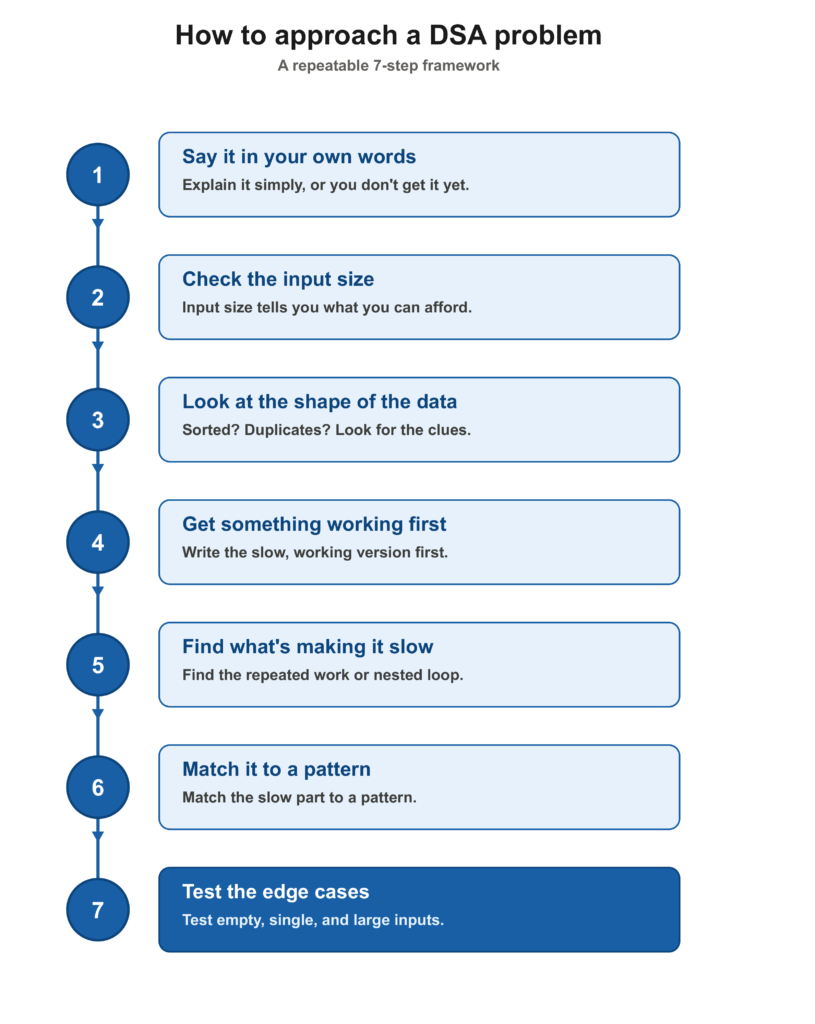
- Say the problem back in your own words. If you can’t explain it simply, you don’t understand it yet.
- Look at the size of the input. It tells you what you can afford. A tiny input hints that a slow, brute-force approach might be fine. A huge one rules that out immediately.
- Look at the shape of the data. Is it sorted? Are there duplicates? Is it a range of numbers? These clues point you to a pattern.
- Get something working first. Write the slow, obvious solution before you try to make it fast.
- Find what’s making it slow. Is it repeated work? An unnecessary nested loop? A search that could be a simple lookup instead?
- Match that slow part to a pattern. This is exactly where the cluster articles above come in.
- Test the edge cases. Try it on an empty input, a single item, duplicates, and the largest input you expect.
How Long Does It Take to Learn DSA?
If you’re already comfortable with Python basics, and you put in a few focused hours a week, many learners find they can reach a solid foundation, solving most medium-difficulty problems and explaining their reasoning out loud, in roughly 2 to 4 months. That’s steady practice, not a single weekend binge. Going slow and understanding why two pointers works on a sorted list will take you further than memorizing thirty different solutions.
DSA with Python vs DSA with C++ vs Java
All three languages teach you the same ideas. The choice usually comes down to what you’re using it for.
| Python | C++ | Java | |
|---|---|---|---|
| How hard it is to learn | Easiest, the syntax stays out of your way | Hardest, you manage memory yourself | In between, more boilerplate than Python |
| Do interviews accept it | Yes, almost everywhere | Yes, sometimes preferred for performance roles | Yes, common in enterprise interviews |
| Built-in tools | heapq and deque ready to go | Powerful but wordier | Solid, but more code to write |
| Best fit for | Learning fast, general interviews | Competitive programming, performance-critical work | Enterprise and Android-related roles |
Python is widely accepted in technical interviews, although some companies or roles may prefer a particular language. If you already know Python, there’s rarely a reason to switch languages just to learn DSA. You can always pick up C++ or Java later, once the concepts themselves are solid.
Common DSA Learning Mistakes
- Memorizing answers instead of patterns. Solving hundreds of problems without asking “what pattern was this?” teaches you to recall, not to think.
- Skipping the complexity check. A solution that happens to be slow will keep being slow on every similar problem, until you learn to notice why.
- Jumping straight to hard problems. Struggling through medium problems first is what builds the instinct that makes hard ones approachable.
- Treating early topics as finished. Arrays and hashing show up again inside tree, graph, and DP problems. Gaps you ignore early tend to resurface later.
- Putting off dynamic programming. It’s the topic most people delay the longest, which only makes the eventual catch-up harder.
Quiz Time
Frequently Asked Questions
Do I need a computer science degree to learn DSA?
No. A CS degree teaches this formally, but you can learn everything here on your own with steady practice and working Python skills.
Is Python good enough for interviews, or should I also learn C++?
Python is widely accepted in technical interviews, though some companies or roles may prefer a particular language. Only pick up C++ or Java later if a specific employer or platform requires it.
Should I learn data structures or algorithms first?
Learn them together. Start with the foundations (complexity and recursion), then move to arrays. A data structure only becomes useful once you know an algorithm that works with it.
How do I know I’m ready for dynamic programming?
Once recursion feels comfortable, especially recursion that returns a value and calls itself more than once, you’re ready. DP is really just recursion with a memory.
Is solving problems on LeetCode enough, or should I study the theory too?
Solving problems without understanding the pattern behind them teaches you facts that don’t transfer. Use a guide like this one to build the mental model first, then use problem practice to make it stick.
How is this different from a typical DSA tutorial?
Every article in this series is built around recognizing patterns, not just explaining them. The goal isn’t just knowing how a technique works. It’s noticing when a new problem needs it.
Conclusion
Data structures and algorithms aren’t really about memorizing a fixed list of tricks. They’re about building a mental toolkit that helps you match a new problem to the right solution. Start with the foundations, move through arrays and linked lists before jumping to trees and graphs, and don’t skip dynamic programming just because it feels uncomfortable at first.
Next, head to What Is Big O Notation? Time and Space Complexity Explained to build the vocabulary the rest of this series depends on.
External Resorces
Python Big-O: Time & Space Complexity Reference
https://pythoncomplexity.com/
VisuAlgo — Visualising Data Structures and Algorithms
https://visualgo.net/en

Leave a Reply